
Artificial intelligence is reshaping the competitive landscape at extraordinary speed. Boards are approving multi-million-dollar technology investments. Executive teams are racing to integrate generative AI into workflows. Strategy decks are filled with automation roadmaps and efficiency projections.
Yet amid this surge of technological ambition, something far more fundamental is being overlooked.
Investment Imbalance and the Productivity Paradox.
Research from McKinsey estimates generative AI could contribute between $2.6 and $4.4 trillion annually to the global economy. Technology budgets are increasing with record investment in AI tools across every department. But parallel investment in human capability development is not keeping pace.
History offers a cautionary pattern. During the Industrial Revolution, mechanisation outpaced worker education and management capability, resulting in decades of social unrest and delayed productivity gains. When factories first electrified, leaders initially replaced steam engines with electric motors without redesigning workflows. Productivity barely moved and it was only when organisations restructured work and reskilled their people that the true gains were realised.
The same occurred during the early years of the IT revolution — technology was visible everywhere, yet productivity lagged until leadership practices and digital literacy evolved. In 2023, MIT researchers claimed AI implementation could increase a worker’s performance by nearly 40% compared to workers who didn’t use technology. But emerging data is failing to show these promised productivity gains.
Each time, the bottleneck wasn’t the technology, it was the human adaptation. The Age of AI will be no different.
Economists call this the Productivity Paradox. Technology alone did not create value, it was the combination of organisation redesign and human adaptation. This is exactly where we are now as many organisations are layering AI onto old processes rather than redesigning work and upgrading thinking. While investment in AI is accelerating, anxiety is rising with it. If AI changes how we work, the greatest risk for leaders and their teams is not developing the uniquely human capabilities that create value alongside it.
The World Economic Forum’s Future of Jobs Report identifies analytical thinking, creative thinking, resilience, leadership and social influence as the fastest-growing skills in importance. These are not technical skills; they are cognitive and relational capabilities. Yet most organisations still approach AI transformation primarily as a technology implementation challenge rather than a human capability challenge.
This is the blind spot.
AI augments execution. It processes information at scale and generates outputs at speed but it doesn’t exercise judgement, build trust or sense human fear in rapidly changing work environments. Leaders need a new model to lead, manage and coach their people through this time of exponential change.
The Human Advantage Model
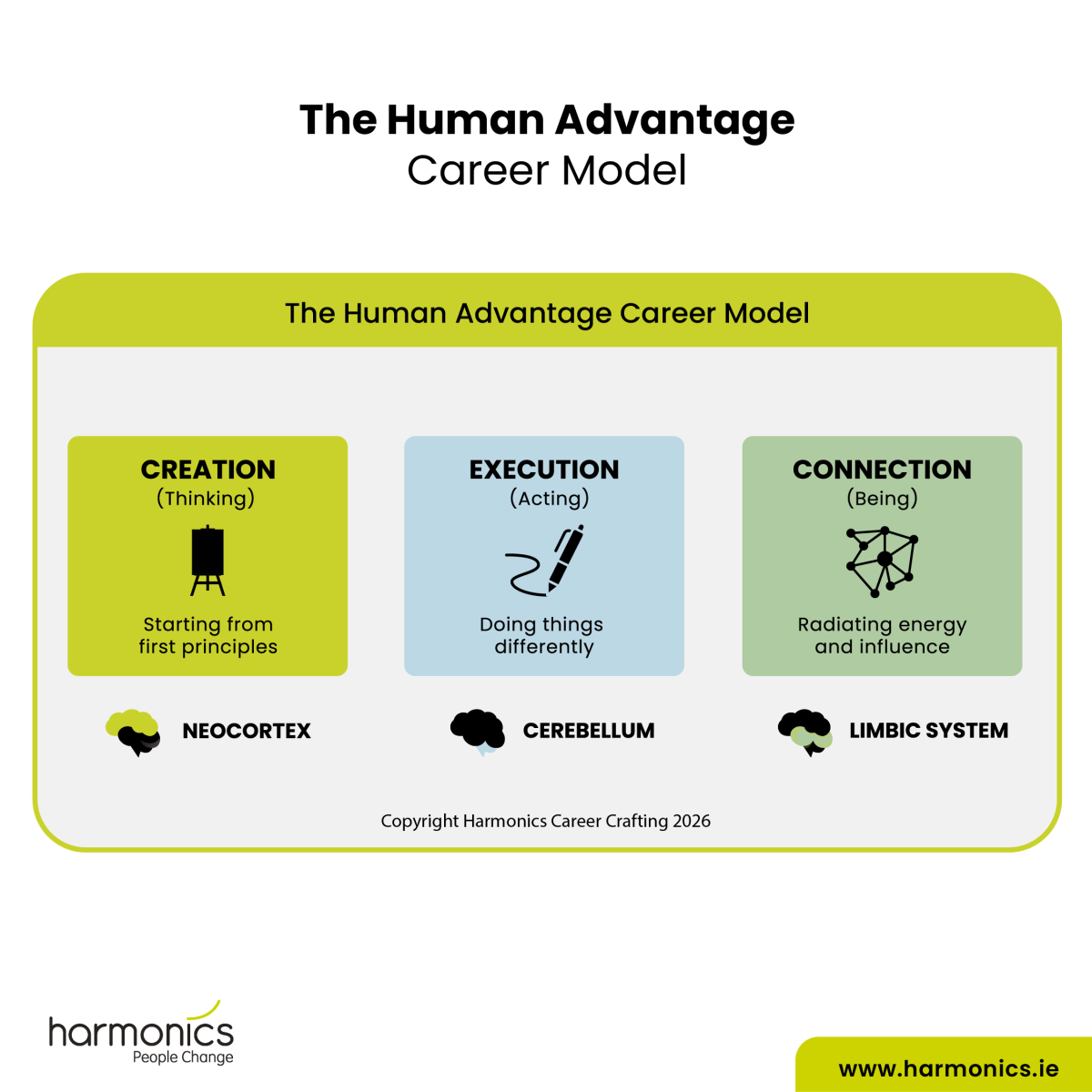
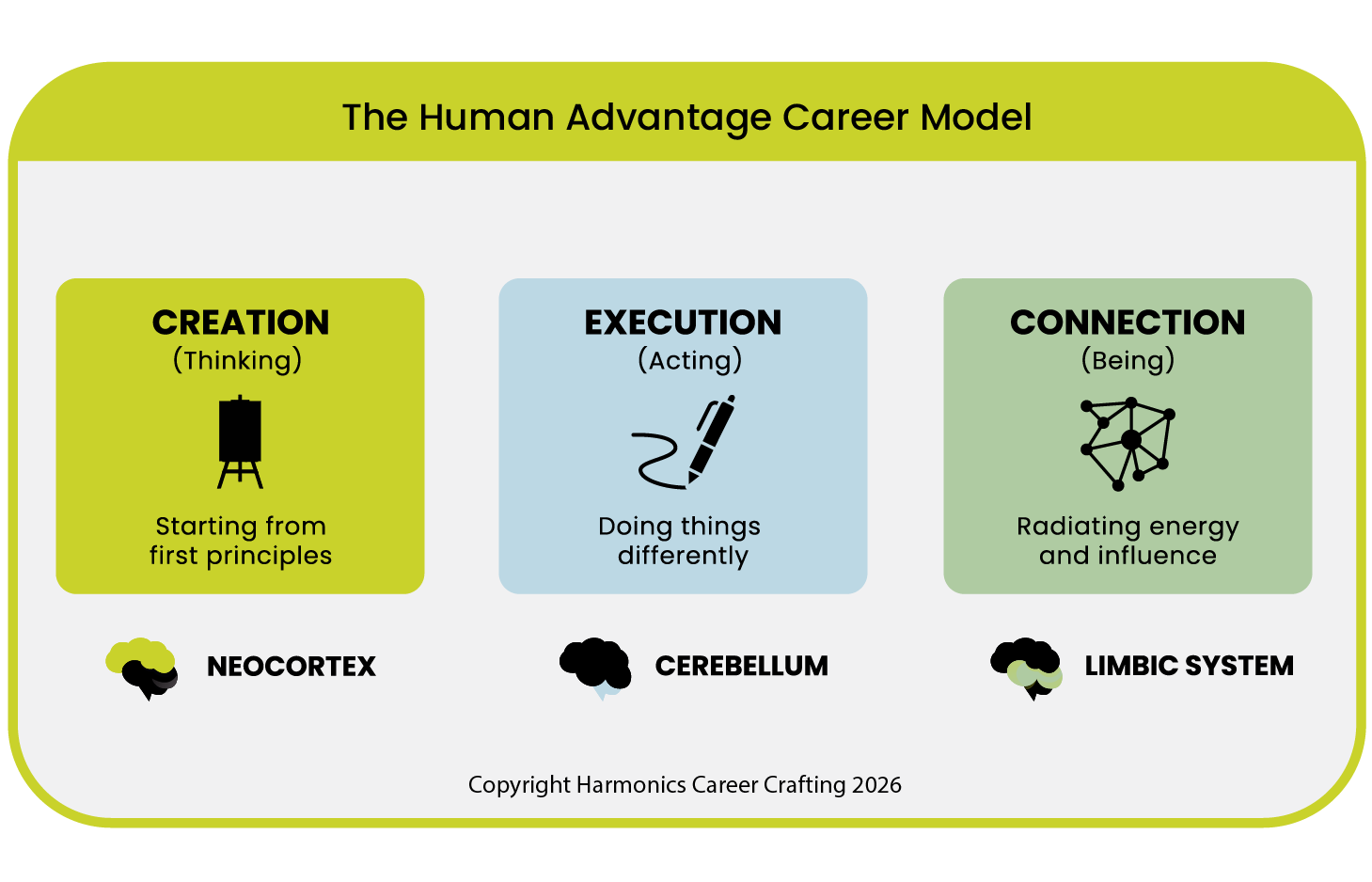
We are in an era when we are upgrading our machines faster than we are upgrading our minds. The Human Advantage Model (below) gives leaders an upgraded operating system to adapt and anticipate future change. The model illustrates three interdependent systems of the brain and body that underpin future performance.
- The neocortex helps humans to pause, think and create.
- The cerebellum stores memories and habitual ways of executing.
- The limbic system acts as the brain’s regulator for energy, motivation and connection.
Together, these interdependent systems help us to think, act and feel in a uniquely human way. AI is programmed with data to think and act but has no human feelings as it operates on algorithmic data, probability and simulating emotions rather than experiencing them.
The ‘Human Advantage Model’ helps leaders to play to their strengths and truly differentiate in the future. Let’s explore each of these three interdependent systems a little closer.
The Neocortex – The thinking brain
The neocortex is responsible for higher-order thinking: critical thinking under uncertainty, ethical judgement in ambiguity, complex decision-making, strategic reasoning of AI generated insight and good governance.
In a world where AI can generate answers instantly, the value shifts from producing information to evaluating it. AI can draft strategies, model scenarios and summarise research but it cannot determine what truly matters in context. It cannot weigh moral implications, integrate organisational culture, political nuance, and long-term consequence in the way a mature leader can.
This becomes even more important when we understand the neuroscience of threat. When individuals feel anxious or unsafe, the brain’s threat circuitry becomes more active. Cognitive flexibility decreases and creative problem-solving narrows which impacts the quality of decision making under pressure.
In times of rapid technological change, fear suppresses the very cognitive functions leaders need most. The responsibility of leadership, therefore, is not only to think well but to create environments where others can think well too. If AI expands the information landscape, the neocortex must expand its interpretive and integrative capacity. Leaders must consciously develop higher-order reasoning skills and coach their teams to do the same.
The question shifts from “How do we use AI?” to “How do we strengthen judgement in an information overloaded world?”.
Three ‘thinking brain’ leadership questions to reflect on:
- Am I critically evaluating both the outputs and the assumptions of AI?
- Do I rush to premature certainty or can I hold complexity long enough to see patterns others miss?
- Do people around me feel safe enough to challenge, question and reason or are they operating in protective mode?
The Limbic System – The relational brain
If the neocortex drives thinking, the limbic system governs emotion, motivation, and social connection. In periods of transformation and uncertainty, emotional contagion spreads quickly and activates threat responses. The rumour mill accelerates and psychological safety erodes.
Research consistently shows that high-trust organisations outperform low-trust ones in productivity, innovation, and retention. Google’s Project Aristotle identified psychological safety as the number one factor in high-performing teams. Deloitte’s human capital research links belonging and growth to financial outperformance.
In uncertain times, trust is productivity. AI cannot generate trust, create belonging and repair relationships. It cannot hold space for people to discuss their fears or inspire confidence in a shared future. That is the work of the limbic leader.
The future demands leaders who can regulate their own emotional responses, influence intentionally, build psychological safety and communicate with clarity and empathy.
When leaders dismiss AI anxiety, they inadvertently amplify it. When they acknowledge it and create the time and space for people to be heard, they increase trust and restore cognitive capacity. Connection is not a “soft” capability, it is a key prerequisite for performance.
As automation increases, human differentiation will depend increasingly on relational depth, trust and emotional intelligence. The organisations that thrive will be those where leaders intentionally cultivate relational capital alongside technological capability.
Three ‘relational brain’ leadership questions to reflect on:
- What emotional state am I transmitting when I enter a room?
- Am I acknowledging anxiety and concerns about AI or unintentionally dismissing it in the name of optimism and progress?
- How often do I reflect on the emotional impact of my communication, not just the content?
The Cerebellum – The acting brain
The third dimension of the Human Advantage Model is execution but not execution as it has traditionally been understood. AI changes the mechanics of doing. Workflows are being redesigned and routine cognitive tasks are being automated. The leader’s role is not to compete with AI in speed or data processing. It is to integrate AI intelligently into human-led systems.
This requires a mindset shift from linear execution to augmented execution. Future-ready teams will need to learn how to prompt effectively, redesign processes around AI capability, experiment and iterate rapidly and validate AI outputs critically.
This is not simply sorted by taking a technical training module, it is a behavioural mindset shift. Leaders must learn to coach curiosity and role model adaptability to overcome resistance and defensiveness in their teams.
Execution in the Age of AI is less about doing more but more about doing differently. The danger is that organisations automate existing processes without redesigning them. The opportunity lies in rethinking value creation altogether. The Human Advantage model makes this clear: AI enhances the speed at which we can now do, but humans must elevate how we think and how we connect to thrive in the future.
Three ‘acting brain’ leadership questions to reflect on:
The Leadership Imperative
Much of the current workplace mood reflects survival psychology. When people feel threatened by automation, they default to protective behaviour. They narrow their focus, resist change and disengage. The Age of AI will only amplify the importance of human leadership.
- With information becoming abundant, human judgement becomes a scarce resource.
- When automation increases, trust becomes the differentiator.
- When speed accelerates, clarity will be required.
The Human Advantage model offers leaders a practical lens to evaluate their leadership effectiveness across these three interdependent systems of the brain and body:
The Neocortex– To use our thinking brain to start from first principles and see the world for what it is today rather than the biased lens of our past work achievements.
The Cerebellum – To recognise we are creatures of habit, we operate over 90% of the time on autopilot, we need to retrain our brain to do our work differently with AI.
The Limbic system – To become more aware of our feelings and how we radiate energy (positive or negative) from within to those around us. Humans follow meaning not mechanics!
The Human Advantage model creates an inspiring way forward for leaders to shape their own future in domains machines cannot occupy. AI may change how we work, but how we think, connect and act will determine whether we merely survive this era of transformation or truly thrive within it.
John Fitzgerald
Managing Director, Harmonics
Harmonics supports Organisations and their Leaders with Organisations Design, Leadership Development and Executive Coaching for nearly twenty years. We also facilitate offsite sessions with leadership teams and share our insights about work in the future. If you are an Organisation leader and would like to know how Harmonics can support, you through this period of exponential changes. Contact us to learn more.
