Categories
Blog

Rejection… leads to… Redirection

Redundancy as an opportunity to reassess your career

“It wasn’t until I lost my job, I realized how lost I was in my job”.

Meta’s news today along with other global tech firms has started a wave of downsizing to reduce costs. Investor backed tech firms have grown exponentially in recent years which led to rapid hiring to meet demand. Now just as quickly when the tide turns, we are seeing rapid firing.  Once confidence dips in the markets, the first way many corporates know to stall a share price fall is to make a downsizing call.

In Ireland, we are protected by employment legislation laws around terms and conditions for redundancy, which cushions the blow. In the remote world of work, we now live in, some impacted by these layoffs will be leaving colleagues they never physically met!

In our Outplacement work, I have met thousands of people just after they hear this emotional news. When I meet them, they are often hurt and experiencing feelings of sadness, loss, shame, and anger. They are fearful, not knowing what to do next. It’s an emotional tsunami of feelings as neurochemicals are flooding through the body. They are in a survival emotional state.

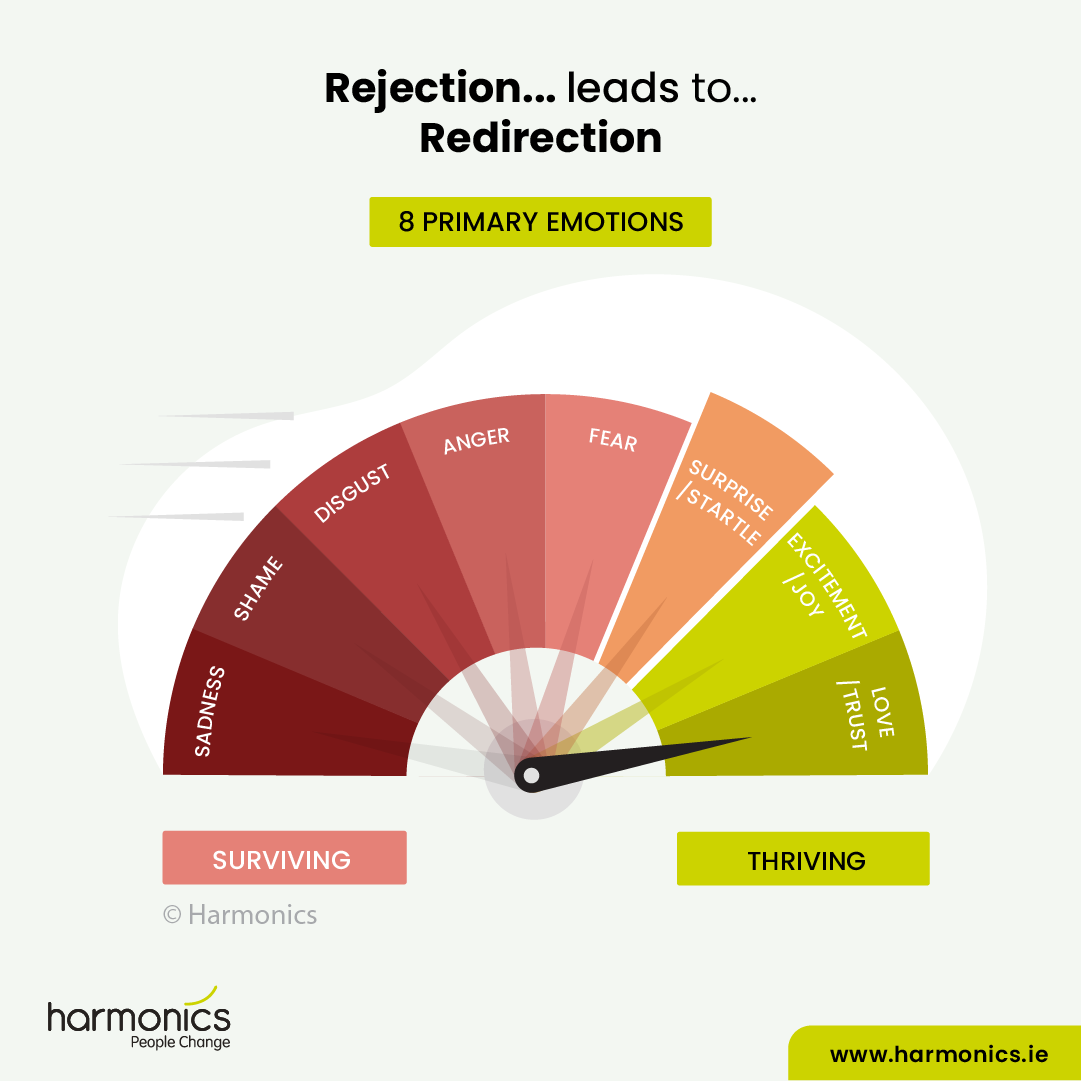
The Emotional Spectrum Model illustrates our 8 primary emotions. The 5 primary survival emotions are Fear, Anger, Disgust, Shame and Sadness. They historically protected us from danger when we were being physically attacked. When you lose your job these survival emotions kick in because your self-worth is under attack.

But, the surprise/startle emotion is a potentiator and can flip response states. Between stimulus and response there is a space, this space offers choice. Rejection is an opportunity for Redirection.

Redirection takes time and when you are anxious and fearful, you want the quick fix, the next job! Time is needed to do a career stock-take to clarify how you could move to the thriving side of the emotional spectrum. This is where you seek out roles which bring you excitement and joy. Working in a thriving culture where you are trusted and valued. These are the attachment emotions which bring career happiness and engagement.

In the past two years especially, I have come across many people permanently operating from survival emotions. They are stressed and burned out in their work. They haven’t taken the time to reassess their future career direction. Bad as this news of redundancy will be for some, it is the opportunity to press pause and reappraise their definition of career and life success.

One person I coached through job loss said to me lately – “It wasn’t until I lost my job, I realized how lost I was in my job”.

If you are facing redundancy, I would ask you these three questions to help you do a career stocktake:

  • What emotions were you regularly experiencing each day at work?
  • When in your career past have you been at your best and what made it so?
  • What strengths and skills do other’s say you bring to a project and why?

John Fitzgerald is the Founder of the Harmonics Group. Harmonics specializes in helping organizations plan for change, manage change and support their people through change.

Follow Harmonics on LINKEDIN and keep up to date with trends in the World of Work
Categories
The Chord Future of Work Podcast

How HR can Shape a Future of Work Strategy

Episode Overview: The Future of HR and Employee Experience with Nicole Dessain

In this episode of The Chord, John Fitzgerald talks to Nicole Dessain, founder and Chief Employee Experience Designer at Talent Imperative.

Nicole helps companies like Apple, Cisco, Comcast, Edelman and McDonald’s create human-centered, inclusive talent programs.

In this episode, Nicole discusses how the role of HR is changing and how HR can shape a Future of Work Strategy. Nicole also explains her point of view on design thinking at the intersection of strategy, innovation, culture, and talent in 2022.

Hope you enjoy the show!

Categories
Blog

The 3 Core Questions to ‘Future Proof Your Career’

I am meeting a lot of people recently who know what they don’t want but don’t know what they want! They are often busy and burned out and need re-direction.

I want to share a simple but powerful model we have used with over 30,000 people in helping them to future proof their career direction.

This model is based on the principles of neuroscience and is used by every successful business to adapt and anticipate future change – so we have adapted this model for careers.

Neuroscience has shown us the human brain has three regions; the ‘instinctive’ reptilian region which is great for taking action and getting stuff done. The limbic system helps us to understand our own and other’s emotions and building new influential connections. The neocortex helps us to stand back, take stock to make decisions about the future.

The brain is lazy and wants to follow the same tried and tested pathway as yesterday. We know from neuroscience, 95 percent of our daily brain activity is unconscious, so most of your decisions, actions, emotions, and behaviour are on autopilot. To future proof, you need to disrupt these habitual patterns to create new neural pathways in the brain and so too new career pathways.

The three regions of the brain give us everything we need to future proof, but from our experience we tend to overload on ‘doing’. This is where the robots thrive executing routine tasks, so as humans we now need to be smarter to stay ahead.

Think firstly about how great businesses balance these three regions of the brain. They need to step back from ‘operations doing mode’ to ensure they are in-tune with their clients changing needs. They do this by conducting ‘research and development’ to adapt their services to stay relevant for the future. This is enhanced by their ‘sales and marketing’ teams in staying close to customers to gain a premium price.

To Future Proof Your Career – You too need to stop being busy in ‘instinctive doing mode’ to take time to reflect and do your own ‘research and development’ to ensure you know what’s changing in the future of work. Once you know what skills and opportunities are in demand, it is within your agency to upskill and/or reskill to increase your market value. You must also do your own ‘sales and marketing’ to build influence and position yourself for what you want not what is simply offered to you.

What We Know Is – We are living in a time poor society; we are ‘always on’ but rarely reflective. We spend too much time in doing mode – what we call ‘the busy box’. Mobile and Digital technology is stealing our focus and distracting us from what we really want. The Great Resignation and Quiet quitting are all symptoms of increasing stress and burnout. What is needed is time out take stock and future proof your career.

Here are 3 Great Questions to Future Proof Your Career

  1. Research and Development – What is changing in my Profession, Organisation and Sector. What skills will this demand?
  2. Operations – What skills and work environment give me energy and bring out the best in me?
  3. Sales and Marketing – Who needs to know I am seeking new career growth experiences and the skills I have to offer?

The Harmonics Career Stocktake Process is an immersive 1-1 coaching process we offer to both Organisations and to Individuals to help them reflect and reskill to reposition their career on what they really want for the future.

If you are interested in finding out about Harmonics Career Stocktake Coaching Programme, please contact Liam Mc Donnell Harmonics lmcdonnell@harmonics.ie for a confidential chat and we will forward you our brochure

“Know who you are. Know what you want. Know what you deserve. And don’t settle for less.” -Tony Gaskins”

John Fitzgerald is the Founder of the Harmonics Group. Harmonics specializes in helping organizations plan for change, manage change and support their people through change.

Follow Harmonics on LINKEDIN and keep up to date with trends in the World of Work