
Categories
Blog

It’s the Environment Stupid

James Carville, Bill Clinton’s campaign manager for the 1992 Presidential election once claimed “it’s the economy stupid” which proved a highly successful strategy. He focussed on what was concerning people most and this had the greatest resonance.

Why environment matters in talent and career management

In observing many organisations’ approach to Talent and Career Management, I believe many are not focussing on what is concerning people most. You might say “it’s the environment stupid!”. Bruce Lipton first coined this phrase in his excellent book ‘The Biology of Belief’. Bruce is one of the foremost thinkers in the revolutionary field of Epigenetics. He observed the impact a changed environment had on the cells he was studying. The cells changed their structure and function depending on their environment. These cells were shaped by where they live. It’s the same with people in organisations today, you and I are shaped by where we live and work.

They need to change! – We get many calls each week for Executive Coaching assignments. The assignments are common in nature – “Can you support a manager who needs to change their management style, develop their emotional intelligence and leadership capability?”

HR will share with us how their CEO would like a particular Senior Manager to change. In certain cases, these coaching assignments are remedial as it’s not about how the manager is or isn’t working out or changing, quite often, it’s the environment! The environment needs to change but no one is willing to have the courageous conversation with the CEO or the site leadership about why or how it needs to change. Organisations are outsourcing the problem to Executive Coaches to fix the unfixable problem. The problem is not just the person, it is the person in the environment.

Courageous Conversations – We know from Bruce Lipton that if we changed the environment this coachee could change. Instead, we are being asked to mould managers uncomfortably into a structure that does not work for them. Courageous conversations are not being had. The problem is often caused by the system, yet we focus on trying to fix the person. The answers are all in nature. Stay with me here, I am not going all earthy, I am simply speaking about you and me (human beings) who have evolved and adapted for the last 150,000 years on this planet. We thrive in systems that offer autonomy, mastery and purpose as Dan Pink confirms in his book ‘Drive’ on the psychology of motivation. See his Ted Talk here.

The pyramid structure – Institutional models are largely a creation of the industrial era. They were created to keep the managers who had all the knowledge at the top of the pyramid and the worker bees at the bottom on the production line. These traditional hierarchical legacy systems are no longer ‘fit for purpose’ for the future of work. The transition to more natural models is proving quite a challenge and this is where a lot of the tension lies in the system. There is a lack of courage to change from what we know, even though the industrial model is only over 100 years old. Instead, we try to change the person. I am not for one minute saying Managers don’t need coaching to develop their leadership capability. What I am saying is that it is a shared responsibility between the organisation changing and the person changing. Change is the order of the day and research below is a case in point.

The CEB Enterprise Performance Research in a multiyear global study showed some interesting findings from 23,000 respondents in answering what change they have seen in the last 3 years:

• Greater Organisation complexity 44%
• More interdependencies 50%
• Increased access to information 56%
• Co-workers in another global location 57%
• Work that requires collaboration 67%

New capabilities and critical skills are required by Organisations that demand greater collaboration, sharing knowledge and staying closer to the customer. This cannot be managed successfully in a traditional pyramid structure. There is a seismic shift happening in the way we are working. There is, and will continue to be, a shift away from the individual who is in it just for themselves or the hero leader who hoards information and knowledge to achieve their personal goals and bonus. People can see through this today and don’t like being used as pawns in the system. If they see this happening, they purposely slow the system down or leave, thus giving your competitors the advantage.

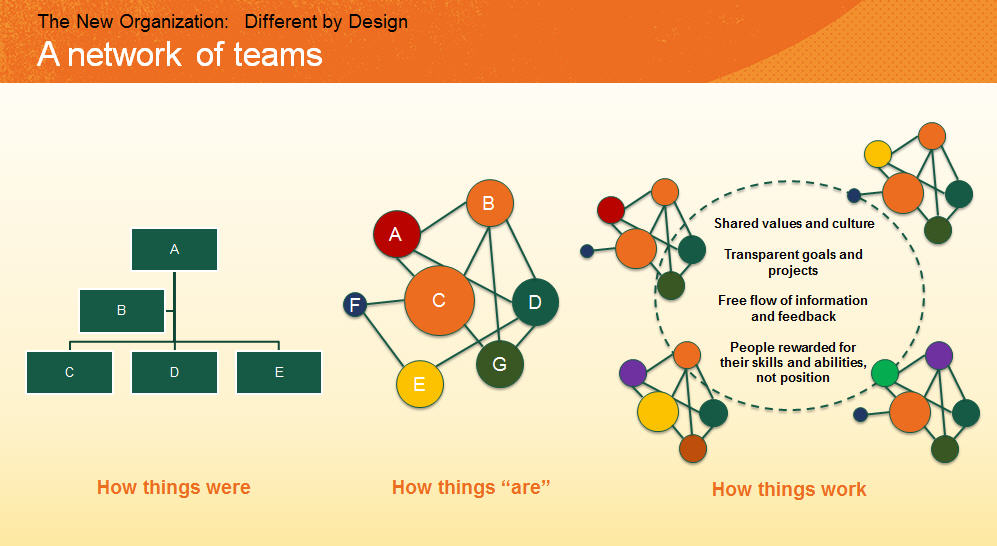
Model from Josh Bersin, The New Organisation: Different by design

The big shift is to collaborative working, greater interdependency and access to new sources of changing information. The future organisation needs to be fluid and this requires agile individuals and teams who give and take information freely and speedily to deliver better enterprise solutions. This fluid system is simply a representation of the biological cell system. The cell system is not a hierarchical one, it is a networked system all working in unison. The hierarchy requires higher level decisions, slows information response time and causes blockages in the system, yet organisations still adhere to this traditional pyramid structure.

If you want to foster agile working and greater innovation you need to create a networked organisation. Many Leaders will share with us “If only they could get their people to change”. The CEB research contradicts this view and highlights “it was not employee willingness to change that was the problem; it was the environment structures and heritage practices that blocked innovation”. We are moving from the industrialised economy to the connected economy. Control and job titles are being replaced by innovation, agility and varied work tasks.

Your organisation is more than likely a spider’s web full of interconnected networks rather than an ordered pyramid. Organisations need to value and reward contributions of those with critical expertise and those who collaborate both inside and outside the organisation to enable innovation. Your Leaders need to know who these people are and have career conversations to understand their motivators, career aspirations and skills they are capable of developing in the future.

Feel the Fear and Do it anyway – In our experience, HR are fearful of challenging the CEO and Leadership on their thinking. They do not believe they have enough clout and will not be taken seriously because they do not have an accountancy degree or a background in business. In other cases they fear for their jobs if they rock the boat. The HR role is to gather that presenting data for change and become more influential in helping to change the structure of their future organisation. With the onset of automation, it will be your people’s ability to innovate and influence that will be the key differentiator. Lean and Six Sigma programmes have in many cases taken out costs and made many businesses more efficient.

The future is about adding value and driving a culture of agility and innovation. This is harder to measure and predict the end result. Boardrooms like certainty, if you do x you will get y. This is why many Leaders are stumped. They are fearful of changing away from what they know because there isn’t a proven model. They need to understand there won’t be a proven model because change is happening so fast. The future is about adapting as you go. If you wait you will die, if you adapt you will fail sometimes and win sometimes. The future of work is going to be a roller coaster.

Career Frameworks are needed to reflect the new reality of the more networked organisation. We are living in a highly connected open networked world of work. There is a need to build strategies to support more networked organisations. Chris Ernst in his research work featured in his book ‘Boundary Spanning Leadership’ found that the greatest challenge Leaders found was in enabling people to make horizontal cross functional moves. Organisations speak about the scarcity of talent in the market; they spend lots of money trying to attract new talent but from our experience are not doing enough to reimagine their in-house talent in upskilling them to make cross functional moves.

Some reflective questions in summary

• Is your environment enabling or disabling your Talent Management Strategy?
• Are you avoiding a courageous conversation with a Business Leader out of fear?
• How many of the 5 changes in the CEB study impact your organisation and how are you preparing your people?

If you would like to speak to Harmonics about any of the above, here are just a few of the interventions we make available to clients

• We share our insights in Future of Work talks on Leadership off-sites to introduce external thinking into traditional businesses. We challenge Leaders to think differently and come away with fresh perspectives on the environment they are creating to attract and develop talent.
• We deliver ‘career conversations’ workshops to enable leaders and managers have courageous conversations about creating career growth opportunities that match business challenges.
• We design Career Frameworks that reflect a modern networked organisation that is close to the customer and offers non-traditional internal career transition moves to meet changing business needs.

Categories
Blog

What’s your next Transfer Move?

It’s January and it’s a busy month of the year for Transfers in the Premiership Football season. Sky Sports has a Transfer Centre to update us on the latest big money moves before the transfer window closes. These Premiership Football stars have their agents to advise them and negotiate big money moves between clubs. Alexis Sanchez recent move from Arsenal to Man United will see him earn a staggering £600,000 a week, yes a week.

It’s also hectic Transfer season for Employers scouring the market for new talented stars to join their teams. All this transfer talk got me thinking about the many talented people we meet that have to make life changing decisions by accepting or turning down a job move.

Here, I have looked at four categories of people we meet – you may identify with one of them – and I highlight some of the career advice I might be giving you if you retained me as your Highly Paid Agent?

So where are you now in your career?

In my experience, you are somewhere broadly in one of these 4 categories:

  1. Reactive/Curious – You are not actively looking but have been contacted by a recruiter for a new job, you don’t feel now is the time to move but you are curious why you were contacted
  2. Reactive/Ready – You have been contacted by a recruiter, you have not been job seeking but with the right offer would be open to consider new moves
  3. Proactive/Ready – Your role is going to made redundant or you have experienced redundancy and keen to get back into another job
  4. Proactive / Curious – You are proactive and always testing the market to see what further career opportunities are out there. You are not ready to move right now but always keeping an eye to the future

Reactive/ Curious

You have received a call or a LinkedIn message out of the blue; a recruiter would like to speak to you about an opportunity. Let’s face it, it is flattering, we all like to think someone wants us. Even if you are really happy in your current role, it peaks your interest even to find out how much they might offer. If you do return the call, it can open up an interesting conversation about a new role in a new sector. My advice is to be curious, find out more about the employer, their challenges and how they compare to your employer. A word of warning, you may also be contacted as a result of a robotic AI recruitment process churning out matches to your LinkedIn profile. This leads to a conversation with an inexperienced junior recruiter with little business experience busily trying to hit their monthly sales targets. The increase in online recruitment means you are going to get many more suggested job offers than before. Take time each week to review your LinkedIn requests and build career connections with a select number of quality recruitment professionals. They have lots of personal connections to employers and you never know when you will need them in the future.

  • Be curious and ask valid questions to increase your market knowledge
  • Don’t ignore, a courteous reply is never wasted, stating the type of role you would like to be contacted about in the future

Reactive/Ready

You have been contacted about an open role and after a conversation, the role sounds appealing and you would consider a move. The recruiter would like to put you forward for an interview. Remember, you are at all times in control of your personal brand and the CV that is forwarded will need editing and tweaking to marry the job specification. It is not enough to ask the recruiter to tidy up your CV. Your CV is your personal brochure and it speaks volumes for your brand. Get professional support to make it the best you can in advance of forwarding. I have found people are poor to highlight their own achievements but it is very easy for me as a career coach to ask questions to uncover these achievements. This work also helps with your upcoming interview and marrying your relevant experience to the role requirements. If you consider going forward for the role, write down 3 big reasons why you want the role and commit to give it everything in the interview process. I have seen people contacted about a role and adopt an attitude that the employer has to prove to them why they should work for them. If the employer feels they have to impress on you so much why you should take it, the future work relationship is doomed for failure. Like in any relationship, there needs to be a mutual commitment to making this work

  • Present your brand in the best way possible at interview, even if you don’t end up taking the job, remember hiring managers move jobs too, so you never know where you might meet them again
  • Review the process, your learnings and any potential development gaps you may not have realised you had pre-interview

Proactive/Ready

As a result of a restructure you have found yourself out there again proactively trying to find a new role. As we deal with a lot of outplacement candidates, this is often a time where we see urgency getting the better of common sense. Proactive job search is a process. There are steps in every process, but urgent job seekers will want to skip vital foundation steps in an effort to get to find another job. Certainty is replaced with uncertainty. This leads to panic replies to every potentially suitable job advert online. My advice is to clearly define what your ideal next role looks like. You don’t go online to buy any car, any dress, you shoes. You have a good idea what you want and what style, model and colour will suit you.

I cannot tell you how many people fail to do this exercise. What work tasks ideally would you be doing, in what sector, at what salary level, in what location, in what type of culture, what next challenge appeals to you and why, what type of company describes this list? When I get people to complete this exercise, I then speak about their gaps to finding this role. These gaps might be network, education, skills or salary expectations. To address gaps you need to reinvest in your learning. This could be practical or academic. I have just worked with someone and there gap is a network in a new sector. Once we started to discuss who may be in that sector, names started dropping. They had more connections that they had thought. This was their gap. When I ask some urgent job seekers to complete this exercise, they say “I just want a job, as any job is better than no job, I just need to get back earning again”. I say yes, but you also want to get back earning in an environment where you will thrive rather than just survive and soon want to leave.

  • Clarify what your ideal next job looks like, you simply have to know what you are looking for before you find it, otherwise you allow yourself to take a job that’s not for you
  • Address your network, skills, education or salary expectation gaps as these are your barriers to future career success

Proactive/ Curious

You are happy doing what you are currently doing and wouldn’t describe yourself as actively job seeking. But you have the mind-set of a top football player who always seems to be in control of a game. Top sports stars don’t just focus on the outcome, they focus on the process. This is a critical mistake a lot of people make in their careers. They target one future role as the Holy Grail. I once coached a client who told me that in his twenties he ambitiously set a goal to be a Country HR Director by the time he hit 40. He worked hard and exceeded his own expectations by reaching the role at 36 years of age. He was sent to me for career coaching at 39. He had achieved his lifetime ambition but when he got there felt unfulfilled. He was still only 39 and had not thought about the next 25-30 years. He had one focus that, when realised, was not what he once thought it might be like. This hero’s journey to the top often follows with questions like “what’s next?”
The top footballers can see a potential future move before anyone else. They can sense the way the game will go from fine tuning their skills. In the modern career game, you need to see the world of work as an evolving series of game changing events. You need to learn to spot new potential opportunities that are a match for your skills and talents. If you don’t, someone else will.

  • Scan the internal and external market for new future projects and opportunities, like a great footballer, you have your ‘head up’ looking for a gap to exploit
  • The career game is a process, there is no one ‘holy grail’ job, best to focus on a series of intrinsically rewarding career growth moves.

If you remain proactive and curious throughout your career lifetime, you will largely remain in control of your future career moves. If you choose to remain reactive, you will always be adapting to fit into someone else’s idea of what they think you should do. Speak to one of our team of Harmonics career coaches and let us be your insightful agent to gain that extra insight before you feel pressurised to make the wrong move for you and your future.
Every success for your next career move.

People who end up with the good jobs are the proactive ones who are solutions to problems, not problems themselves, who seize the initiative to do whatever is necessary to get the job done.
― Stephen R. Covey

Categories
News

Harmonics Donates €3,000 to Limerick Suicide Watch

Harmonics supports Limerick Suicide Watch with charity donation

A cheque worth €3,000 was presented to Ger McNamara, chair, Limerick Suicide Watch by John Fitzgerald, managing director, Harmonics Group. Harmonics, a people change consultancy with headquarters in Limerick, selected Limerick Suicide Watch as its charity of choice for 2018.

Limerick Suicide Watch is a group of volunteers who patrol the four bridges of Limerick City at night time. The group’s main focus is to keep eyes on the river and bridges and identify and provide support to those in distress and who may be contemplating suicide.

Presenting the cheque, John Fitzgerald of Harmonics said, “One of our core values at Harmonics is making a difference and this year our team decided we wanted to help the volunteers of Limerick Suicide Watch with this donation.”

“As a Limerick headquartered business, we see these volunteers make a huge difference in patrolling the four main bridges in Limerick city for those who are distressed or suicidal. We meet a lot of people each year who are incredibly stressed when their role is made redundant. Our role through career, personal and financial coaching and advice is to help them bridge the gap between one job and another. This is often the most challenging times of their lives when they have lost their previous identity and they feel out of control. We are often the only people they feel they can speak to openly and honestly about how they feel without feeling judged. This charity partnership with Limerick Suicide Watch for 2018 makes sense for us all on the team at Harmonics. They are an amazing bunch of people who really make a difference, he continued.

Accepting the cheque on behalf of Limerick Suicide Watch, Ger McNamara said, “Limerick Suicide Watch would like to express our gratitude to Harmonics for their generous donation to our group. We could not operate successfully without such generosity from the public and companies like Harmonics. All donations we receive are used to supply our volunteers with the necessary training and life saving equipment required to patrol safely and also for the maintenance of our equipment such as bikes and radios and the upkeep of our base.”