
Categories
News

All Star Accreditation for John Fitzgerald

John Fitzgerald Receives All-Star Thought Leadership Accreditation

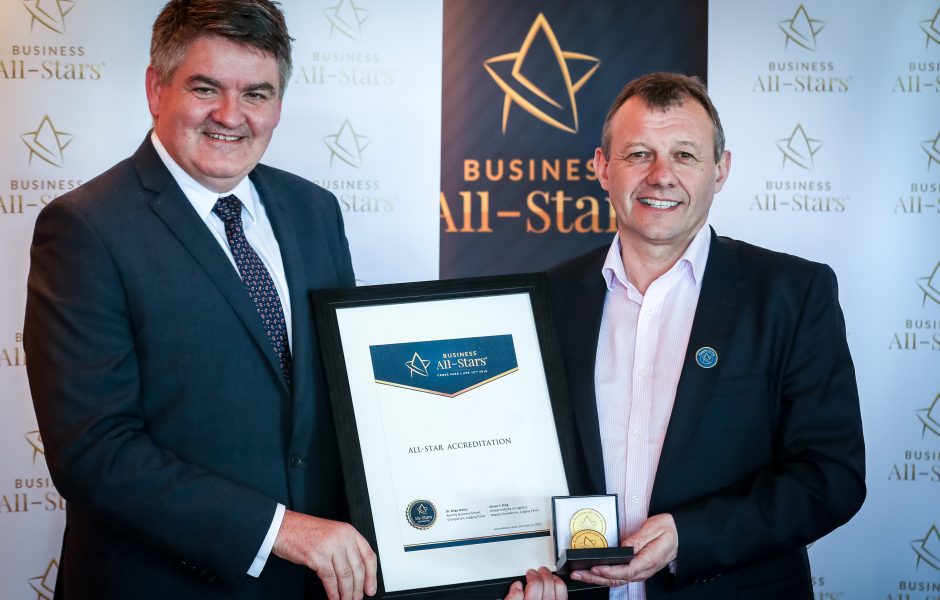
John Fitzgerald, managing director at Harmonics Group, received an All Star Accreditation for Thought Leadership in Career Management at the Fourth Annual All-Ireland Business Summit powered by Audi.

Leading lights in Irish Business descended on Croke Park last Thursday 19th April for the Summit, where a 1000 strong audience from all 32 counties were captivated by the speakers who revealed their top secrets, confessions and the do’s and don’ts that have helped them achieve their business success.

The Business All-Stars competition final was one of the key elements of the summit. The Business All-Stars is an annual competition designed to identify, recognise and accredit Irish companies and individuals that have distinguished themselves in the conduct of their business over the last 12 months.

Speaking at the event, Kieran F. Ring, CEO Global Institute of Logistics, Deputy Chairperson Adjudication Panel said; “The decision to designate John Fitzgerald, Harmonics with this accreditation is based on the score achieved in four rounds of intense competition.

The Deputy Chairperson had this special mention for John. “I was delighted to be part of the process which identified John Fitzgerald as a Thought Leader in Career Management. Johns ability to a ‘walk a while in another person’s shoes’ is a unique gift which allows him to give the best possible guidance to both parties in the employer / employee relationship, balancing the need of the corporate to optimise its most valuable resource, its people with the needs of the individual to develop a sustainable, rewarding career path. Congratulations John, our hope is that this accreditation will further distinguish you”.

The application, supported by references, interviews and independent ratings from the ‘mystery shopper’ process left the adjudication panel in no doubt that John and Harmonics is richly deserving of this accreditation. We would like to extend our sincere congratulations to all concerned and we wish you every success for the future”

In response to the announcement John Fitzgerald said, “On behalf of Harmonics I would like to express our sincere thanks for being accredited as Thought Leaders in Career Management. Achieving All-Stars accreditation is a great source of pride for us and we look forward to continuing to meet and indeed exceed the standards set by the All-Star programme.

The process which led to this accreditation truly stretched us, the structure of the competition required us to put our brand story on paper and gave us the opportunity to reflect on who we are, our growth strategy and above all the value we create for our target audience.

The opportunity to hear first-hand feedback from our Judge-Mentor, our existing customers, partners and suppliers through the reference module combined with the results from the mystery shopper round was invaluable.

We would like to thank all at the competition for making the effort to listen to our story, understand and accredit our business and above all help us to promote it”

The competition finals benefited enormously from the atmosphere created at the All-Ireland Summit which was driven by the three key pillars of knowledge sharing, facilitating new business relationships and the continued improvement of business standards in Ireland, the All-Ireland Summit improves year-on-year – like so many of the great teams to have graced the hallowed turf of Croke Park.

Speaking at the summit, Dr. Briga Hynes, Kemmy Business School, University of Limerick, Chairperson Adjudication Panel summed up the entire process by reminding the enterprises honoured with All-Star that:   “Harmonics has demonstrated an ability to innovate and has impressive growth plans which no-doubt reflects the resilience and optimism that are the hallmarks of Irish entrepreneurs. Harmonics brings a real inspiration for what is possible in business in Ireland and provides important role models for the many aspiring entrepreneurs and existing small firms,”

 Harmonics now included in the 2018-19 All-Stars Role of Honour, the list is published annually to coincide with the All-Ireland Business Summit at Croke Park

Categories
Blog

5 Great Questions to Ask Yourself If You Hit a Career Ceiling

5 Questions to Ask Yourself When You Hit a Career Ceiling

This article was originally published in April 2018. It has been substantially updated in May 2026 to reflect flatter organisations, AI’s effect on careers, and what ‘the ceiling’ looks like now.

Hitting a career ceiling has changed shape since I first wrote about this.

The classic version… too many candidates, not enough seats at the top table is still real. But in flatter, skills-based organisations, more of my coaching clients are hitting a different kind of ceiling: the one where the role they’re great at is quietly being reshaped underneath them, often by AI, and “up” isn’t the obvious answer anymore.

Either way, the work starts in the same place. You have to hold the mirror up first.

As an Executive Coach, I worked some years ago with Rachael (not her real name). She worked diligently and went well beyond the call of duty to deliver big projects. When she came to me, she needed urgent interview prep for an upcoming internal promotion. Unfortunately, she had left it too late.

She had been busy working in her job but had neglected to work on her career. She was frustrated with what she described as an old boys’ club in her organisation, and she’d ignored it on the assumption that her hard work would be rewarded in time. Surely they couldn’t overlook her. But they did. She was, in effect, considered too good in her current role to promote out of it.

More truthfully: she was so busy doing the job that she had never developed a successor, never built influence beyond her own team, and never made it visible what she wanted next. She had made herself irreplaceable and had fenced herself in. When I challenged her, she admitted she preferred to stay within her area of expertise. The comfort zone, as she later conceded.

Five questions to ask yourself

Hitting the ceiling happens for different reasons. Here are five questions to work through. The answers will help you figure out the next best move.

Question 1: Is it them, or is it me?

Before you blame the culture, be honest with yourself. Have you built a career brand that makes it obvious you wanted this next step — or have you let your work “speak for itself”? Are you seen as a flight risk if you’re passed over, and if not, why not?

Look at the organisation’s track record on internal moves. Who got promoted in the last two years, and why? Just as importantly: what’s the track record on internal moves that aren’t straight promotions — lateral steps, secondments, project leadership? In flatter organisations, that’s often where the real progression sits, and people who only optimise for the rung above miss it.

Question 2: Do you need to step out before you step up?

Stepping out is about becoming visible, influential, and known by people outside your day job. Stepping up is what happens after you’ve stepped out often enough.

Stop being busy in your day job and start creating opportunities to influence across and above it. That means cross-functional projects, putting your hand up for the work that’s slightly outside your remit, and being deliberate about which meetings you attend.

If you’re working hybrid, the visibility job is harder, not easier. The corridor conversations that used to happen by accident now have to be engineered — deliberate in-person presence on the days that matter, scheduled calls with leaders outside your team, a clear answer to the question “what are you working on?” when someone senior asks you in the kitchen.

Question 3: How influential is your network inside the business?

Stepping out demonstrates capability. The leverage that actually breaks the ceiling is executive connection.

Find ways to be in the company of the people who decide. Get to know them; get interested in their world. Find out what their pain points are and what’s keeping them up at night. Reflect on how you could be part of the solution — and let them know what you want to do next, and why.

By the time you walk into the internal interview, the decision is largely made. What carries weight is who in the room already knows what you want and trusts you to do it. That work happens in the months before, not on the day.

Question 4: Have you overstayed your welcome?

Sometimes not getting promoted is the alarm clock you needed.

Is it time to get up and go? Maybe, on reflection, the role you were chasing wasn’t for you anyway. Maybe you’ve stayed too long, and if you stay longer, you’ll plateau.

In the years since I first wrote this article, I’ve seen far more clients leave well — with a plan — than leave reactively. The shift in attitude towards job moves has helped people get this decision right. The starting point isn’t “do I leave?” It’s “am I as employable as I’d like to be if I needed to?” If the answer is no, the work begins now — invest in skills, network outside your sector, become marketable.

Question 5: Are you ready for what the next role actually needs?

Most of the people we coach evaluate their performance in the role they currently do, not the role they’re applying for. That’s the gap that surprises people in interviews.

Seek honest feedback from people who know you well and who don’t need you to like them. A coach is one option; a former boss you trust is another. The feedback you don’t want to hear is usually the feedback that matters.

What happened with Rachael

Rachael accepted the feedback and described one of our sessions as “the day the alarm clock went off.” She enrolled in an external development programme and started building a network outside her own organisation. We assigned her a Communications Coach to build her influence and brand internally. She began mentoring her future successor. She told her CEO what she wanted next, and why.

She is now working smart, not just working hard. Time is ticking, and she’s making herself ready for internal or external moves. The day she didn’t get the promotion turned out to be the day she woke up.

When the ceiling isn’t about promotion

A growing share of the people I coach in 2026 aren’t hitting a competitive ceiling — they’re hitting an obsolescence ceiling. The role they’re excellent at is being quietly reshaped by AI, automation, or organisational redesign, and the path “up” doesn’t exist in the way it used to.

The five questions still apply, but they apply differently. “Is it them or is it me?” becomes “have I been investing in skills the business will still need in three years?” “Have I overstayed?” becomes “Am I in the right sector for the kind of work I want to be doing for the next decade?”

The instinct to hold the mirror up first still serves you. The questions are just bigger now.

“Talent sets the floor, character sets the ceiling.”
— Bill Belichick

If any of this resonates

If you’re sitting with one of these questions and not sure what to do with the answer, that’s usually the moment a coaching conversation pays for itself.

If you’d like to talk through where you are with one of our Executive Coaches, book a 30-minute career coaching consult.


John Fitzgerald
Founder, Harmonics Group

Harmonics specialises in helping organisations plan for change, manage change and support their people through change. To learn more about our programmes, please contact us on 061 336136 or email info@harmonics.ie

Categories
Blog

The Number 1 Most Common Mistake HR Makes

Creating Work Environments Where People Can Learn, Experiment, and Thrive

Have you ever looked on in wonder at a young child totally immersed on their mobile device playing their computers games. They immediately go into their own world. This is a world of simulation, a repeating process of trial and error. Here the real learning happens; they must through exploration find the best way to gain a higher score in their computer game. They are continually trying new ways, raising their own skills and awareness. They are in competition with their peer community and they know who has attained the highest score. They are eager to climb the rankings to more challenging levels. To be competitive in this environment, they know they need to learn from their mistakes, and start again at zero if they fail. They accept failure as just a part of the game. They have autonomy to be creative and competitive in their chosen field without anyone telling them they look or sound stupid or giving negative feedback when they make a mistake. They know when they played bad, they don’t need telling; they just dust themselves down and go again. When they make a mistake they almost instantly know where they went wrong and how to make it right next time.

But at work they are warned to ensure they get it right first time. If they don’t, it will have big consequences. The boss, line manager or colleague shows them up in public and tells them and everyone else just how wrong they got it. Taking risks, trying new ways, being innovative are all espoused as something organisations want more of, but they better get it right first time! This leads the adventurous gamer who takes risks in their personal life to play safe and within the rules, fearful of doing something wrong at work. At home, this gamer tries, fails, tries again and fails, each time learning, adapting and raising their own performance standards even further. The difference? They have freedom within the framework of the game and are committed to learning and being the best they can be.

We are asked by HR departments for interventions to help shake their people up, to motivate them. When we delve into the problem we’re told their people are often on autopilot, working hard, but fearing they will get it wrong.  It’s understandable. A person’s standard rarely improves once a task is learned. At work, we become ‘lifelong doers’ instead of ‘lifelong learners’. Performance reviews don’t help much either, it’s a tick the box exercise for both parties. It’s no surprise that virtually every sector has seen their productivity flatline since around 07/08. The Global Gallup study shows employee engagement pretty much stagnant at 33%, year after year.

HR chases too many Fads’ – I see too many fad HR initiatives being rolled out in response to poor career development scores in employee engagement surveys. Fads don’t work but they tick the box that the organisation was seen to offer something to address the issue. Let’s do a motivational talk or a talk on managing stress and everyone will know then what to do when they are stressed. No, they won’t because the work environment will not change the day after the inspirational talk. These initiatives are all targeted at helping the person to change behaviour. We have seen from our kids playing computer games that if you create the right environment we will thrive to be better. It’s the environment that needs to change; this is a much bigger prize for HR to go after. This will bring the Big Win longer term. This is how HR will become more strategic and influential.

Stop going for the low hanging fruit HR with health and well-being talks, gyms on site and short-term fad’s. These won’t work if people are still working 60-hour weeks. These won’t work if you report into a boss that is known to be a bully and has poor relationship skills but is never challenged on their behaviour. Things won’t change if you are rewarding managers and employees to stay in roles too long. Start taking some risks – challenge your senior leadership team to create environments that enable talent to thrive, not plateau or leave.

I had a conversation recently with an organisation that has 97% retention. They wanted to increase movement around the organisation to build new skills, but found it hard to do this. The problem is a mud layer of managers at a certain level in the organisation, who have stayed too long and have no intention of leaving. It is their comfort zone and the organisation has facilitated this mud layer. They also found that new graduates are not staying. Why would they? They have nowhere to go. They can see no career prospects while the mud layer of management stay where they are. The organisation had a problem but didn’t know how to change it and create a high-performance culture. With our support, this was a goal worth pursuing which won’t just tick the box. We are transforming their culture and helping drive commitment, performance and productivity.

Engaged employees are in the game for the sake of the game; they believe in the cause of the organization.” –Paul Marciano, PhD.