
Categories
Blog

Watch this Space!

Career Transitions Require Time

Following a telephone conversation with a panicked Senior Executive this week, I felt compelled to share his story with those who may be in the same situation now or at some point in the future.

The Senior Executive recently left his former employer and was due to start an Executive Outplacement programme with Harmonics in 10 day’s time as part of his exit package. A bespoke programme of outplacement support was developed with his needs in mind and comprehensive pre-work was sent to him to complete in advance of the first session.

But he called this week in a state of blind panic. He had met someone for coffee who told him that he needed to get back on the horse ASAP and not leave a gap in his CV. Their career advice suggested he needed to start job hunting sooner rather than later or he would regret it. This friendly advice led him to this urgent call to bring forward his first session to the following day as he needed to update his CV before the end of the week and start job hunting immediately.

Like many who have faced a job-hunting period, he was in an emotional place.  In his early fifties, he had never been out of work before and felt out of control. Trying to speak to him in a logical manner was not working because of his state of fear and panic. He was like a man racing into Harvey Norman before a deadline because he had just heard the advert, “when these jobs are gone, they’re gone!” His friend had put the fear of God into him, that he would never get another job if he didn’t take the first one that came along.

We have fine-tuned the Harmonics Career Transition methodology after working with thousands of people over the last 10 years. It works and it delivers job placement success when practiced. But it is a process and there is an art and a science to how we work. The science piece first. Executive Job Search is very much like the birth of a new baby because it typically takes 9 months from conception to delivery. This man wants a baby in 9 hours not 9 months!

The 9 Month Gap

A nine month career transition might seem like a very long time for an emotional Executive, but finding the right opportunity takes time. It’s important to allow space and time to come to terms with often emotional endings after a long service with one employer. Next, we help them create a new career identity to grow within them first so that they can then communicate this articulately to their network and potential stakeholders in their next career move.

A few years back, during a first Outplacement session, an IT Director demanded that I help him find work in 6 weeks as he didn’t want a gap on his CV. Knowing he had lots of IT project management experience, I asked him if he could deliver a complex 9 month IT project in 6 weeks. He said it wouldn’t be possible as there would be too many variables and stakeholders involved in the project and the client wouldn’t get the results they wanted. Short cuts would not deliver the outcome required. I agreed and shared the similarities in career transition. It is often overlooked that Executive Search projects typically take 6 months, so why would his Executive job search take any less?

Restricted by the Paradigm of the Past

Instead of using the opportunity to take stock, many candidates go back to what they know. They design their future career move from the paradigm of their past role. They are limiting themselves by their own bias, prior experience, former job title, industry sector and career specialism. In career transition, and with more time on their hands, people will meet well-intentioned friends for a catch up coffee to start networking. These coffees turn into multiple career advisory sessions. These friends are all well-meaning but the career advice is clouded by their own bias and likely siloed view of job search. Our methodology at Harmonics brings people through a guided process on what they have to supply, what skills are in demand and bridging the gap between both – but only when we have mapped out the full picture.

100 Yard Dash to Nowhere

Back to my panicked caller. The friend offering career advice had never changed jobs themselves but knew of someone else who had struggled to get a job after they were made redundant. It turned out to be someone with few relevant skills or qualifications so inevitably they found it harder to find a job. We need to be careful who we listen to in life!

I spoke to him about how he needed to make the next move the right move, rather than just another job. His first session would not focus on just his CV but on designing from first principles to create the best outcome for him. This Harmonics Career Transition methodology is a once in a lifetime process, to take stock rather than a CV writing service. In career coaching, we aim to create a Career Destination on the map before we set off at pace in a race to an unknown land. This 100 metre dash video clip from the famous Monty Python sketch team will give you a laugh and an idea of what people can be like when they start out in career transition.

Managing Uncertainty is a Key Trait for Future of Work

Leading and managing through uncertainty is one of the key traits for successful leaders in the future workplace. How he manages through this period of change will serve him well if he listens to his intrinsic motivators and trusts his intuition. Change is a process and it takes time to readjust and re-calibrate our career direction. The gap in your CV is often now viewed by recruiters as someone who took the time to ascertain what they wanted rather than a rapid response to the first job that comes along.

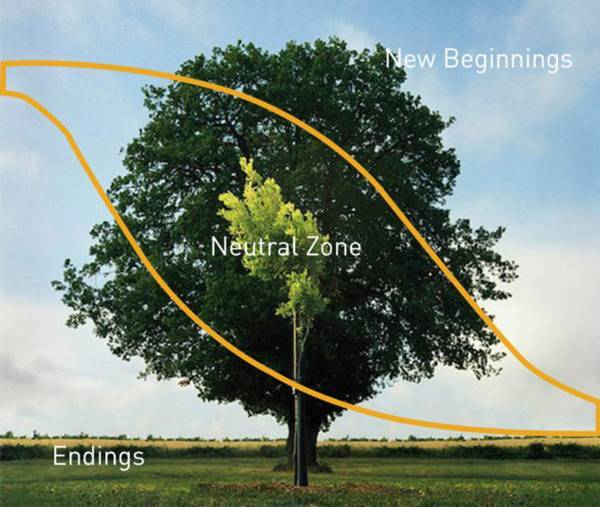
Change is not a straight line and the Bridges Model of Change makes so much sense for those in Career Transition. This quotation from Susan Bridges sums up for me the space we need to give ourselves between endings and letting go of the past before the new can come to life.

“The essence of life takes place in the neutral zone phase of transition. It is in that interim spaciousness that all possibilities, creativity and innovative ideas can come to life and flourish.” —Susan Bridges

Personal Innovation Project

I encourage people to think about their career transition as if they were going to work on an innovation project for an employer wanting to transform the way they do business and re-position for the future.  Set your transition up as a Personal Innovation Project and take the time to redesign your future not based on the old principles of the past, but with a blank slate and focused on first principles.

My parting career transition advice

  1. Design from first principles – start with a blank canvas not from your former job title
  2. Start from the inside out – Ask “what do I want?” rather than “what will others say or think?”
  3. Trust the process of nature – It takes time but all new babies do too!

Let nature be your guide and trust the science and methodology of the career transition process. Personal renewal starts with rest, the brain needs sleep to refuel, the baby needs time to grow, the seeds planted in spring can only be harvested in autumn.

Watch this Space

If you are in between jobs or know anybody who would benefit from reading this blog, please share. There is no need to panic; it is just the space you need to create between endings and new beginnings.

“The secret of change is to focus all of your energy not into fighting the old but on creating the new” – Socrates

Categories
Blog

Holding Out for a Package to Arrive?

Do you know anyone waiting for a package? There are so many among us who have given years of service to one employer and would love a change but think they should hold on for the Voluntary Severance package. Working in career transition for years, at Harmonics we know there comes a time (somewhere after 8 years) when people feel they have too much to lose by leaving without a package. And there can be a sense of entitlement that others before them have received packages so why not them.

I define people who are waiting for the package as FedEx. Fed up with where they work but waiting for an Ex Gratia payment from an employer to leave.

This FedEx mindset can be detrimental to their careers. In this article, I share some tips on how to manage your career better and honour your talents.

Waste of talent

There is a lot of well documented waste in the world like food, energy, water but there is even more wasted talent in Organisations. I have seen too many people wait and wait for the package, year after year, and allow their talent to waste away. They’ve told me privately they would be gone in the morning if only there was a package going. They speak about having to follow protocol, keep the head down, how their boss is a living nightmare and the work environment will never change. One civil servant recently described themselves as “being imprisoned by the system”. The statements are always filled with negativity and powerlessness to change anything. The end result is that the person has plateaued in their career and wasted their talent waiting for the package.

So what would do if the package arrived tomorrow?

When I ask what exactly they would you do if they left, the response is usually “anything else but this”. I could count on one hand when someone has articulated clearly to me what they would do if the package arrived. Having a FedEx Mindset removes personal responsibility. Being Fed up with your current manager or employer can be blamed on them and how they will never change. Waiting for an Ex Gratia payment simply means you can’t afford to leave unless you get an attractive enough package to do so. There are many different personal circumstances individuals face when considering whether to stay or leave.

Depression and Regression

Susan (not her real name) recently engaged me as a career coach. She has worked with her current employer for 18 years.  She described the culture as toxic; the canteen chat littered with stories of poor managers, round pegs in square holes, having to do more with less resources, etc, etc. If the rumour mill is true, a Voluntary Redundancy Programme may open up in the coming year.

Susan came to me because she didn’t know what else she could do if she took the package but she wanted to broaden her career options. She took personal responsibility to pay for career coaching privately to create a new future beyond what she only knows now.

In recent years, Susan suffered from depression and was on medication. It became clear to her, as we worked together, that her depression was directly linked to her workplace environment. Susan had taken medication for depression for the first time in her life, all the time waiting for the package to arrive and letting her skills to regress. Now she cannot bear the thoughts of another 10 years waiting for a package and knows she needs to get out.

What to do while you wait for a package to arrive

While I don’t encourage people to wait for a package, sometimes their level of debt and personal situation means it is the only realistic thing to do. Susan has a big mortgage, is the main earner in the home and a family that will need college education soon. She needed to know what her family’s financial needs are before making the next step.  Susan completed a personal financial exercise with my colleague Liam Croke, MD of Harmonics Financial in advance of knowing what the package could be.

She also completed a Career Stocktake Programme with me to evaluate her new career options. The work we have done together has completely opened her mind to using her talents and skills in a new way in a new sector. She is now working actively on her future with an excitement she hasn’t experienced since she first started out in her career almost 20 years ago. Now, with a realistic plan B in train, the negativity in her workplace washes over her head. She is committed to her new future and growing her network of connections and knowledge of new careers outside her own sector. She knows where she is going and why. She is off all medication and feeling like a new woman.  She has joined a reading and yoga class and found new friends outside her negative workplace.

Bridging the Certainty Gap

There is always a gap people will have when making a career transition. The gap between what they have now. This includes the certainty, the structure, the known, the same people in the canteen, the same route to work. Even though this place is not where they want to be, there is a certainty and security about the old and proven.

Making a career move seems a lot harder the longer you have been with one employer and especially into a new sector. You are unknown, unproven, uncertain and fearful you might fail. As children, we don’t worry about failing, we just fall and get back up again and try to walk and eventually make it. As adults, we have a lot invested in our former selves, who we are and often worry way too much about what others may think. Bridging this gap and trying something new is filled with the opportunity to make mistakes, rejection and loss. Change can be like a turbulent flight; you can expect moments when you do need to tighten your seat-belt.

It sounds scary, yet the people, who we have helped transition with the proper career and financial planning ahead of time, tell me instantly they would never go back to the old. They tell me “They needed a push”, “My instinct was right”, “I put up with it for way too long”, “I knew I could do it”. We simply dishonour our talents by waiting too long for the package.

Parable of the Talents

I was reminded recently in a coaching session about the parable of the talents. The coachee shared his father’s guidance when he was growing up: The parable of the talents was an instruction for the disciples to use their God-given gifts which were seen to include personal abilities (“talents” in the everyday sense), as well as personal wealth. What a wonderful message to have endured the course of time from father to son.

Four Questions to Consider

Here are four questions I ask people considering why they feel they need to change. I get them to think about career transition as if they were spring cleaning their house:

  1. What do you want to keep? It will often be what they do best, my most important values
  2. What do you want to discard? It could be old habits, a toxic work environment
  3. What do you want to change? It may be self-limiting beliefs, a new role, a new challenge
  4. What do you want to add? These could be new skills, knowledge and networks

If you are honest with yourself in completing this exercise, you have authored your own reasons on what you need to change and why. Allowing yourself to wait and plateau without taking action on this list is doing you and your employer a disservice. It is like staying in a marriage for show and not being really committed.

Three Important Lessons

Susan has learned three important lessons:

  1. If you need to wait for a package because of your financial situation, start the process of change yourself and commit to it so that it becomes harder to stay than leave.
  2. If your job has had an adverse effect on your health, then this is only a symptom. You need more than a doctor’s prescription, you need a career stocktake to take you out of the toxic environment.
  3. If you don’t feel brave enough to do it on your own, engage the help of a career coaching professional who has worked with many people just like you for support.

In summary, if you are over 5 years with your current employer and can sense that you are at a plateau, don’t wait for 8 years or 18 years to feel powerless to change. Don’t wait to be told by your manager where you should move in the organisation or to be offered a package. Take proactive action and recalibrate; take the time to refocus on your career and become reenergised as a result. Be more than ready for that time when the package arrives. Be so ready that, if a new role appears while you are waiting, it is easier to leave. The more often you complete career transitions, the less scary they become. Career transitions become a part of your DNA; you have less to fear and more to gain. You will become more marketable and employable in the longer term.

Be mindful when the package runs out

Always remember the package offers you a certain amount of money which will last for a defined period of time. Reinvesting in new skills and educating yourself with labour market knowledge provides a lifetime platform for new career opportunities. The only barrier to this reinvestment is your mindset and what you believe is possible for you!

“The secret of change is to focus all of your energy not into fighting the old but on creating the new” – Socrates

Categories
News

Harmonics Sponsors CIPD Midwest Event

CIPD Midwest event on employee engagement during organisational change

Harmonics is delighted to sponsor the upcoming CIPD Midwest event where Veteran CNN correspondent Gina London and Harmonics MD John Fitzgerald will examine the HR and Communications challenges associated with driving employee engagement during organisational change.

Taking place on 25th May at the Greenhills Hotel, the event is highly recommended for the HR and business community in the Midwest, plus the event features a BBQ Social!