
It’s September and back to school season. Every household with school going kids are now firmly back into the routine. My daughter Sarah is starting Junior Cert this year and I look at her books and wonder how much has really changed since I went to secondary school. The big difference seems to be schoolbags got heavier with bigger books, yet we are living in a technology enabled age! In this post, I want to share how our life journey from school to college to work can be one of endless opportunities but only if we approach it with the right mindset.
Routine and archaic
Sarah, like me circa 3Oish years ago, is educated in a similar size classroom by teachers who will teach the same subjects with little change year in year out. Each night she has routine homework to do, answering questions and memorizing stuff for her teachers. Unlike me 30 years ago, she can now google the answers from her mobile device. This is an example of humans applying technology to become more efficient in the modern technology enhanced world. And rightly she wonders why she should learn off stuff she can google and find instant answers. Her generation are stuck in an archaic school system falling further behind to stay relevant in meeting the needs of the Future World of Work. There is an increasing and growing disengagement in the classroom between teachers following the system and students who don’t believe in the system anymore. This is leading to increasing stress for teachers, students and parents.
Questions not Answers
Pablo Picasso once stated, “Computers are useless. They can only give you answers.” I think Picasso just meant that real intelligence stems from curiosity or the ability to ask questions. In science, it is curiosity that makes you ask questions and then you go and experiment in order to answer them. So if Picasso were around today, he might ask “why are teachers looking for kids to remember answers that computers can give them in a millisecond?” He might also wonder why our teenage kids are not now educated in live learning labs that foster deeper questioning, curiosity, creativity and social interaction. A great example of teenage kids becoming highly engaged is the Young Social Innovators Project. Here they get to work voluntarily on projects they are passionate about and make a difference to society. They have a purpose and they want to learn.
Disengagement and College Drop Offs – 70%
The current approach to education creates a high level of disengagement in the classroom. Instead of creating well rounded young adults, the one measure of success after six years in second level education is the number of points earned to claim a coveted college place. There seems to be little or no research undertaken by the students or assessment by the college on whether the student is a fit for the course subject matter. This makes it easy to explain why up 70% of students drop out of certain college courses. Interestingly computer science and business courses recorded some of the highest levels of non-progression. Yet these are considered two of the most important courses in terms of preparing for the future of work. The system is badly broken and no one seems to want to fix it.
We need to move away from “heads down and study hard” education only. Space needs to be created for students to explore the Future World of Work and the changing skills required to succeed. This will give them a clear strategy and help them identify the courses and work that align to their talents and market needs.
Disengagement at work – 70%
We progress to the workplace and find the same number; 70% of millennials are not engaged or actively disengaged at work according to Gallup research. Millennials are accused of job hopping, but from experience they are simply looking for organisations with a purpose they can connect to or work which they find challenging with an opportunity to learn new skills and knowledge. They want an environment that stimulates them and offers them opportunities for growth.
Jonathan Mildenhall Airbnb’s Chief Marketing Officer makes this excellent point about purpose. “Purpose-driven companies outperform their competitors in terms of the financial performance of the business, creating much, much more shareholder value than non-purpose-driven companies. There’s also increasing research and data that proves that purpose-driven companies naturally attract top talent, but they also manage to retain top talent as well,”
If purpose driven organisations outperform their competitors, we as individuals need to define our purpose and what we stand for and believe in to outperform our competitors for jobs. We in turn will attract more career opportunities in alignment with our purpose because we are clear on what we want and where we want to work in the future.
Creating Chances – 70%
Dr. Jim Bright co-author of the “Chaos Theory of Careers” shows in his research that approximately 70% of interviewees reported chance events had significantly influenced their careers to date. Change, Chance and Complexity play a huge role in where we end up working. In my own career, this happened many times. The first time was a chance meeting in a Co. Clare hotel lobby with an American entrepreneur in my early twenties. This led me to emigrating to the US three months later and changing career direction. I have seen this play out time and time again in our career coaching practice. A chance meeting at an event leads to a change in career direction. It is complex to explain but it does happen and changes the course of careers at least 70% of the time. In sport, if you don’t create chances, you don’t score. In our careers, we need to create more chances by meeting new and interesting people and learning more about the changing world of work. It is not something we only do when we finish our exams or when we lose our job.
My Career –My Business Model
We have developed the My Career-My Business Model below in response to the rapidly changing future world of work and increasing levels of disengagement and to offer people a practical career model. Let me explain briefly how the model works. It applies strategic business planning directly to career planning. Every successful business will have three core functions;
Research & Development – Develop new products and services to stay ahead of the game
Operations – Manufacture products or deliver services to clients
Sales & Marketing – Create and maintain a pipeline of sales to deliver revenue
If the Business focuses all of its efforts in Operations mode and does not invest in Research & Development or Sales & Marketing, the business will no longer remain commercially viable. New products and competitors will eat their market share. And it’s the same for our careers.
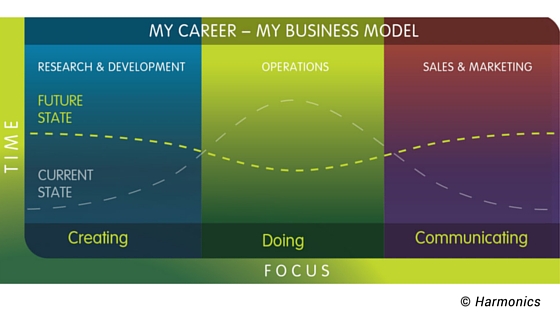
At school, college and work we spend the majority of our time working in Operations or ‘Doing mode’. We have been taught to work hard and you will succeed. The rules have changed and today, we need to work smarter to succeed and this means having a “heads up approach”. Our career advice is to see your career as a business and use the three core functions to guide your career focus;
- Research & Development – Seek to bring new ideas and thinking to the table. As Picasso might say, ask more questions in work meetings and experiment more to add value to your employer and customers.
- Operations – Execute and deliver excellent services for your employers and customers, but do not become swamped with only working hard in this function as the other two functions are door openers to future career opportunities.
- Sales & Marketing – Create and maintain a pipeline of valuable connections both inside and outside your current employer and keep your LinkedIn updated with recent work achievements which showcases your purpose, passion and potential to future employers.
70% Lessons
While we cannot change elements outside our control, like the economy or the environment, we can control the controllables. So, like we used to do in school, to revise on my 70% stats:
70% College Drop Out – This statistic could be reduced significantly if we use our Research & Development Skills to find out what we want to study and why.
70% Disengagement at Work – If we are clear on our career purpose, we can use our Sales and Marketing skills to seek out and attract employers where we will be engaged and aligned to their purpose.
70% Creating Chances – If we are curious and open minded about the wider world and interested in meeting different people outside of our own network, we can change the course of our career direction in the most interesting of ways.


 Q. Do you expect to be delivering this Masterclass again?