
Categories
Blog

5 Great Questions to Ask Yourself If You Hit a Career Ceiling

5 Questions to Ask Yourself When You Hit a Career Ceiling

This article was originally published in April 2018. It has been substantially updated in May 2026 to reflect flatter organisations, AI’s effect on careers, and what ‘the ceiling’ looks like now.

Hitting a career ceiling has changed shape since I first wrote about this.

The classic version… too many candidates, not enough seats at the top table is still real. But in flatter, skills-based organisations, more of my coaching clients are hitting a different kind of ceiling: the one where the role they’re great at is quietly being reshaped underneath them, often by AI, and “up” isn’t the obvious answer anymore.

Either way, the work starts in the same place. You have to hold the mirror up first.

As an Executive Coach, I worked some years ago with Rachael (not her real name). She worked diligently and went well beyond the call of duty to deliver big projects. When she came to me, she needed urgent interview prep for an upcoming internal promotion. Unfortunately, she had left it too late.

She had been busy working in her job but had neglected to work on her career. She was frustrated with what she described as an old boys’ club in her organisation, and she’d ignored it on the assumption that her hard work would be rewarded in time. Surely they couldn’t overlook her. But they did. She was, in effect, considered too good in her current role to promote out of it.

More truthfully: she was so busy doing the job that she had never developed a successor, never built influence beyond her own team, and never made it visible what she wanted next. She had made herself irreplaceable and had fenced herself in. When I challenged her, she admitted she preferred to stay within her area of expertise. The comfort zone, as she later conceded.

Five questions to ask yourself

Hitting the ceiling happens for different reasons. Here are five questions to work through. The answers will help you figure out the next best move.

Question 1: Is it them, or is it me?

Before you blame the culture, be honest with yourself. Have you built a career brand that makes it obvious you wanted this next step — or have you let your work “speak for itself”? Are you seen as a flight risk if you’re passed over, and if not, why not?

Look at the organisation’s track record on internal moves. Who got promoted in the last two years, and why? Just as importantly: what’s the track record on internal moves that aren’t straight promotions — lateral steps, secondments, project leadership? In flatter organisations, that’s often where the real progression sits, and people who only optimise for the rung above miss it.

Question 2: Do you need to step out before you step up?

Stepping out is about becoming visible, influential, and known by people outside your day job. Stepping up is what happens after you’ve stepped out often enough.

Stop being busy in your day job and start creating opportunities to influence across and above it. That means cross-functional projects, putting your hand up for the work that’s slightly outside your remit, and being deliberate about which meetings you attend.

If you’re working hybrid, the visibility job is harder, not easier. The corridor conversations that used to happen by accident now have to be engineered — deliberate in-person presence on the days that matter, scheduled calls with leaders outside your team, a clear answer to the question “what are you working on?” when someone senior asks you in the kitchen.

Question 3: How influential is your network inside the business?

Stepping out demonstrates capability. The leverage that actually breaks the ceiling is executive connection.

Find ways to be in the company of the people who decide. Get to know them; get interested in their world. Find out what their pain points are and what’s keeping them up at night. Reflect on how you could be part of the solution — and let them know what you want to do next, and why.

By the time you walk into the internal interview, the decision is largely made. What carries weight is who in the room already knows what you want and trusts you to do it. That work happens in the months before, not on the day.

Question 4: Have you overstayed your welcome?

Sometimes not getting promoted is the alarm clock you needed.

Is it time to get up and go? Maybe, on reflection, the role you were chasing wasn’t for you anyway. Maybe you’ve stayed too long, and if you stay longer, you’ll plateau.

In the years since I first wrote this article, I’ve seen far more clients leave well — with a plan — than leave reactively. The shift in attitude towards job moves has helped people get this decision right. The starting point isn’t “do I leave?” It’s “am I as employable as I’d like to be if I needed to?” If the answer is no, the work begins now — invest in skills, network outside your sector, become marketable.

Question 5: Are you ready for what the next role actually needs?

Most of the people we coach evaluate their performance in the role they currently do, not the role they’re applying for. That’s the gap that surprises people in interviews.

Seek honest feedback from people who know you well and who don’t need you to like them. A coach is one option; a former boss you trust is another. The feedback you don’t want to hear is usually the feedback that matters.

What happened with Rachael

Rachael accepted the feedback and described one of our sessions as “the day the alarm clock went off.” She enrolled in an external development programme and started building a network outside her own organisation. We assigned her a Communications Coach to build her influence and brand internally. She began mentoring her future successor. She told her CEO what she wanted next, and why.

She is now working smart, not just working hard. Time is ticking, and she’s making herself ready for internal or external moves. The day she didn’t get the promotion turned out to be the day she woke up.

When the ceiling isn’t about promotion

A growing share of the people I coach in 2026 aren’t hitting a competitive ceiling — they’re hitting an obsolescence ceiling. The role they’re excellent at is being quietly reshaped by AI, automation, or organisational redesign, and the path “up” doesn’t exist in the way it used to.

The five questions still apply, but they apply differently. “Is it them or is it me?” becomes “have I been investing in skills the business will still need in three years?” “Have I overstayed?” becomes “Am I in the right sector for the kind of work I want to be doing for the next decade?”

The instinct to hold the mirror up first still serves you. The questions are just bigger now.

“Talent sets the floor, character sets the ceiling.”
— Bill Belichick

If any of this resonates

If you’re sitting with one of these questions and not sure what to do with the answer, that’s usually the moment a coaching conversation pays for itself.

If you’d like to talk through where you are with one of our Executive Coaches, book a 30-minute career coaching consult.


John Fitzgerald
Founder, Harmonics Group

Harmonics specialises in helping organisations plan for change, manage change and support their people through change. To learn more about our programmes, please contact us on 061 336136 or email info@harmonics.ie


Categories
Blog

The Number 1 Most Common Mistake HR Makes

Creating Work Environments Where People Can Learn, Experiment, and Thrive

Have you ever looked on in wonder at a young child totally immersed on their mobile device playing their computers games. They immediately go into their own world. This is a world of simulation, a repeating process of trial and error. Here the real learning happens; they must through exploration find the best way to gain a higher score in their computer game. They are continually trying new ways, raising their own skills and awareness. They are in competition with their peer community and they know who has attained the highest score. They are eager to climb the rankings to more challenging levels. To be competitive in this environment, they know they need to learn from their mistakes, and start again at zero if they fail. They accept failure as just a part of the game. They have autonomy to be creative and competitive in their chosen field without anyone telling them they look or sound stupid or giving negative feedback when they make a mistake. They know when they played bad, they don’t need telling; they just dust themselves down and go again. When they make a mistake they almost instantly know where they went wrong and how to make it right next time.

But at work they are warned to ensure they get it right first time. If they don’t, it will have big consequences. The boss, line manager or colleague shows them up in public and tells them and everyone else just how wrong they got it. Taking risks, trying new ways, being innovative are all espoused as something organisations want more of, but they better get it right first time! This leads the adventurous gamer who takes risks in their personal life to play safe and within the rules, fearful of doing something wrong at work. At home, this gamer tries, fails, tries again and fails, each time learning, adapting and raising their own performance standards even further. The difference? They have freedom within the framework of the game and are committed to learning and being the best they can be.

We are asked by HR departments for interventions to help shake their people up, to motivate them. When we delve into the problem we’re told their people are often on autopilot, working hard, but fearing they will get it wrong.  It’s understandable. A person’s standard rarely improves once a task is learned. At work, we become ‘lifelong doers’ instead of ‘lifelong learners’. Performance reviews don’t help much either, it’s a tick the box exercise for both parties. It’s no surprise that virtually every sector has seen their productivity flatline since around 07/08. The Global Gallup study shows employee engagement pretty much stagnant at 33%, year after year.

HR chases too many Fads’ – I see too many fad HR initiatives being rolled out in response to poor career development scores in employee engagement surveys. Fads don’t work but they tick the box that the organisation was seen to offer something to address the issue. Let’s do a motivational talk or a talk on managing stress and everyone will know then what to do when they are stressed. No, they won’t because the work environment will not change the day after the inspirational talk. These initiatives are all targeted at helping the person to change behaviour. We have seen from our kids playing computer games that if you create the right environment we will thrive to be better. It’s the environment that needs to change; this is a much bigger prize for HR to go after. This will bring the Big Win longer term. This is how HR will become more strategic and influential.

Stop going for the low hanging fruit HR with health and well-being talks, gyms on site and short-term fad’s. These won’t work if people are still working 60-hour weeks. These won’t work if you report into a boss that is known to be a bully and has poor relationship skills but is never challenged on their behaviour. Things won’t change if you are rewarding managers and employees to stay in roles too long. Start taking some risks – challenge your senior leadership team to create environments that enable talent to thrive, not plateau or leave.

I had a conversation recently with an organisation that has 97% retention. They wanted to increase movement around the organisation to build new skills, but found it hard to do this. The problem is a mud layer of managers at a certain level in the organisation, who have stayed too long and have no intention of leaving. It is their comfort zone and the organisation has facilitated this mud layer. They also found that new graduates are not staying. Why would they? They have nowhere to go. They can see no career prospects while the mud layer of management stay where they are. The organisation had a problem but didn’t know how to change it and create a high-performance culture. With our support, this was a goal worth pursuing which won’t just tick the box. We are transforming their culture and helping drive commitment, performance and productivity.

Engaged employees are in the game for the sake of the game; they believe in the cause of the organization.” –Paul Marciano, PhD.

Categories
Blog

It’s the Environment Stupid

James Carville, Bill Clinton’s campaign manager for the 1992 Presidential election once claimed “it’s the economy stupid” which proved a highly successful strategy. He focussed on what was concerning people most and this had the greatest resonance.

Why environment matters in talent and career management

In observing many organisations’ approach to Talent and Career Management, I believe many are not focussing on what is concerning people most. You might say “it’s the environment stupid!”. Bruce Lipton first coined this phrase in his excellent book ‘The Biology of Belief’. Bruce is one of the foremost thinkers in the revolutionary field of Epigenetics. He observed the impact a changed environment had on the cells he was studying. The cells changed their structure and function depending on their environment. These cells were shaped by where they live. It’s the same with people in organisations today, you and I are shaped by where we live and work.

They need to change! – We get many calls each week for Executive Coaching assignments. The assignments are common in nature – “Can you support a manager who needs to change their management style, develop their emotional intelligence and leadership capability?”

HR will share with us how their CEO would like a particular Senior Manager to change. In certain cases, these coaching assignments are remedial as it’s not about how the manager is or isn’t working out or changing, quite often, it’s the environment! The environment needs to change but no one is willing to have the courageous conversation with the CEO or the site leadership about why or how it needs to change. Organisations are outsourcing the problem to Executive Coaches to fix the unfixable problem. The problem is not just the person, it is the person in the environment.

Courageous Conversations – We know from Bruce Lipton that if we changed the environment this coachee could change. Instead, we are being asked to mould managers uncomfortably into a structure that does not work for them. Courageous conversations are not being had. The problem is often caused by the system, yet we focus on trying to fix the person. The answers are all in nature. Stay with me here, I am not going all earthy, I am simply speaking about you and me (human beings) who have evolved and adapted for the last 150,000 years on this planet. We thrive in systems that offer autonomy, mastery and purpose as Dan Pink confirms in his book ‘Drive’ on the psychology of motivation. See his Ted Talk here.

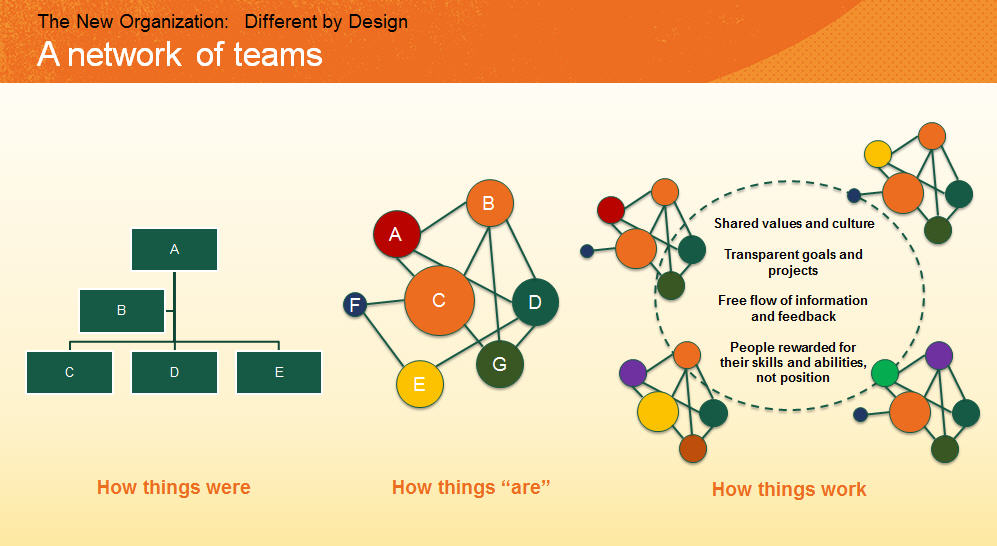
The pyramid structure – Institutional models are largely a creation of the industrial era. They were created to keep the managers who had all the knowledge at the top of the pyramid and the worker bees at the bottom on the production line. These traditional hierarchical legacy systems are no longer ‘fit for purpose’ for the future of work. The transition to more natural models is proving quite a challenge and this is where a lot of the tension lies in the system. There is a lack of courage to change from what we know, even though the industrial model is only over 100 years old. Instead, we try to change the person. I am not for one minute saying Managers don’t need coaching to develop their leadership capability. What I am saying is that it is a shared responsibility between the organisation changing and the person changing. Change is the order of the day and research below is a case in point.

The CEB Enterprise Performance Research in a multiyear global study showed some interesting findings from 23,000 respondents in answering what change they have seen in the last 3 years:

• Greater Organisation complexity 44%
• More interdependencies 50%
• Increased access to information 56%
• Co-workers in another global location 57%
• Work that requires collaboration 67%

New capabilities and critical skills are required by Organisations that demand greater collaboration, sharing knowledge and staying closer to the customer. This cannot be managed successfully in a traditional pyramid structure. There is a seismic shift happening in the way we are working. There is, and will continue to be, a shift away from the individual who is in it just for themselves or the hero leader who hoards information and knowledge to achieve their personal goals and bonus. People can see through this today and don’t like being used as pawns in the system. If they see this happening, they purposely slow the system down or leave, thus giving your competitors the advantage.

Model from Josh Bersin, The New Organisation: Different by design

The big shift is to collaborative working, greater interdependency and access to new sources of changing information. The future organisation needs to be fluid and this requires agile individuals and teams who give and take information freely and speedily to deliver better enterprise solutions. This fluid system is simply a representation of the biological cell system. The cell system is not a hierarchical one, it is a networked system all working in unison. The hierarchy requires higher level decisions, slows information response time and causes blockages in the system, yet organisations still adhere to this traditional pyramid structure.

If you want to foster agile working and greater innovation you need to create a networked organisation. Many Leaders will share with us “If only they could get their people to change”. The CEB research contradicts this view and highlights “it was not employee willingness to change that was the problem; it was the environment structures and heritage practices that blocked innovation”. We are moving from the industrialised economy to the connected economy. Control and job titles are being replaced by innovation, agility and varied work tasks.

Your organisation is more than likely a spider’s web full of interconnected networks rather than an ordered pyramid. Organisations need to value and reward contributions of those with critical expertise and those who collaborate both inside and outside the organisation to enable innovation. Your Leaders need to know who these people are and have career conversations to understand their motivators, career aspirations and skills they are capable of developing in the future.

Feel the Fear and Do it anyway – In our experience, HR are fearful of challenging the CEO and Leadership on their thinking. They do not believe they have enough clout and will not be taken seriously because they do not have an accountancy degree or a background in business. In other cases they fear for their jobs if they rock the boat. The HR role is to gather that presenting data for change and become more influential in helping to change the structure of their future organisation. With the onset of automation, it will be your people’s ability to innovate and influence that will be the key differentiator. Lean and Six Sigma programmes have in many cases taken out costs and made many businesses more efficient.

The future is about adding value and driving a culture of agility and innovation. This is harder to measure and predict the end result. Boardrooms like certainty, if you do x you will get y. This is why many Leaders are stumped. They are fearful of changing away from what they know because there isn’t a proven model. They need to understand there won’t be a proven model because change is happening so fast. The future is about adapting as you go. If you wait you will die, if you adapt you will fail sometimes and win sometimes. The future of work is going to be a roller coaster.

Career Frameworks are needed to reflect the new reality of the more networked organisation. We are living in a highly connected open networked world of work. There is a need to build strategies to support more networked organisations. Chris Ernst in his research work featured in his book ‘Boundary Spanning Leadership’ found that the greatest challenge Leaders found was in enabling people to make horizontal cross functional moves. Organisations speak about the scarcity of talent in the market; they spend lots of money trying to attract new talent but from our experience are not doing enough to reimagine their in-house talent in upskilling them to make cross functional moves.

Some reflective questions in summary

• Is your environment enabling or disabling your Talent Management Strategy?
• Are you avoiding a courageous conversation with a Business Leader out of fear?
• How many of the 5 changes in the CEB study impact your organisation and how are you preparing your people?

If you would like to speak to Harmonics about any of the above, here are just a few of the interventions we make available to clients

• We share our insights in Future of Work talks on Leadership off-sites to introduce external thinking into traditional businesses. We challenge Leaders to think differently and come away with fresh perspectives on the environment they are creating to attract and develop talent.
• We deliver ‘career conversations’ workshops to enable leaders and managers have courageous conversations about creating career growth opportunities that match business challenges.
• We design Career Frameworks that reflect a modern networked organisation that is close to the customer and offers non-traditional internal career transition moves to meet changing business needs.