
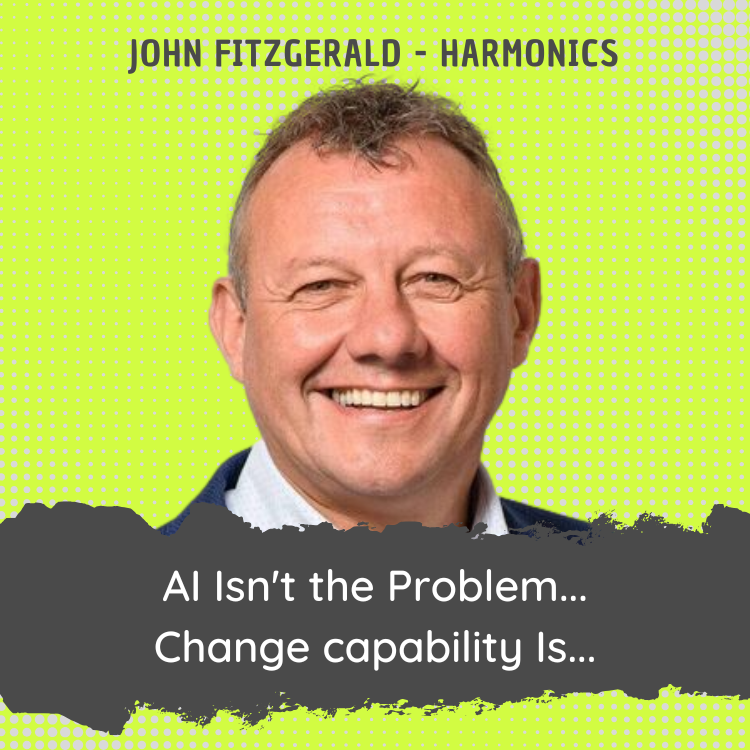
Prefer to listen? This piece is also available as an audio podcast on The Chord — subscribe wherever you get your podcasts.
Every day, we hear that AI is transforming work, replacing jobs, and rewriting the rules of business.
But beneath the headlines, something more interesting is emerging. It’s not the technology that determines success. It’s how organisations help people adopt it.
Recent research from Boston Consulting Group caught my attention. They surveyed more than 12,000 knowledge workers globally and found that 74% are already using AI regularly in their work.
But here’s where it gets interesting.
In organisations with a clear AI strategy:
80% of employees said AI was creating real business value.
Where organisations introduced AI tools without a clear strategy:
60% reported the same.
A twenty-point difference.
Was the difference the technology? No. The technology was available in both organisations. The difference was leadership clarity — and how organisations helped people make sense of the change.
The Organisation Lens
Many organisations still think about AI as a technology project. The discussion centres on software, platforms, budgets, cybersecurity, and implementation.
All of those things matter. But they’re only part of the story.
The real challenge is organisational capability. Because buying technology is relatively straightforward. Changing how thousands of people think, feel, collaborate, and make decisions is something entirely different.
The organisations seeing the greatest value from AI aren’t necessarily buying better technology. They’re investing in helping people adapt — creating learning opportunities, explaining why the change matters, and redesigning work rather than simply digitising it.
One of the biggest mistakes organisations make is assuming that because AI can be deployed quickly, people will adapt equally quickly. But capability doesn’t appear overnight. No more than your confidence in developing a new skill appears in one day.
At Harmonics, we’ve seen this pattern for years. Whether it’s a merger, a restructuring, a new strategy, or digital transformation, the success of any initiative depends less on the quality of the solution and more on people’s willingness and confidence to adopt it.
Technology creates possibilities. People create value.
So organisations need to ask different questions. Not just “What AI tools should we buy?” but:
- What capabilities do our people need?
- What behaviours are we trying to encourage?
- What support will help people succeed?
These are organisational questions — not technology questions.
The Leader Lens
Leaders and middle managers are increasingly becoming the bridge between technology and people.
Organisations are now expecting managers to play a central role in encouraging AI adoption — through coaching, conversations, and performance discussions. That’s a significant shift. Because managers are no longer just implementing change. They’re helping people make sense of it.
And that’s a much more human role.
In today’s world of work, you can’t promise certainty. But you can offer clarity:
- Why are we introducing this technology?
- How will it help our customers?
- What work will stay uniquely human?
- What skills will matter most in the future?
Those conversations matter enormously.
Research from IBM found that 83% of CEOs believe AI success depends more on people adopting it than on the technology itself. Because if leaders only communicate efficiency and productivity, employees hear redundancy and increased pressure. But if leaders communicate the opportunity for learning, experimentation, and growth, people become curious instead of defensive.
Leaders also need to model learning. In periods of disruptive change, credibility often comes from saying:
That creates psychological safety. It gives people permission to experiment, to share their views, and to learn alongside each other.
The Employee Lens
Most employees aren’t resisting the future. They’re looking for direction, confidence, and support.
The organisations that thrive won’t necessarily be those with the most sophisticated AI. They’ll be the ones that help people build confidence alongside capability.
What’s the real lesson?
This isn’t really a story about AI. It’s a story about organisational adaptability. AI just happens to be the latest test.
Five years ago, we were talking about hybrid working. Before that, digital transformation. Before that, restructuring and globalisation.
The technology changes. The challenge doesn’t.
The organisations that succeed will be the ones that build the capability to help people navigate uncertainty. Because change is no longer an event. It’s the way organisations operate today.
There are AI courses springing up everywhere, promising to teach people how to converse better with this new technology. I went on three AI courses over nine months when all this hype started. Each time, I was told the rules had changed and what I’d learned was already out of date.
What hasn’t gone out of date is helping people to adapt and manage through change.
Change is always emotional before it’s operational.
Continue the conversation
If this has prompted you to think differently about change in your own organisation, we’d love to hear from you. At Harmonics, we’ve spent twenty years supporting organisations, leaders, and their people to anticipate and adapt to change.
To learn more about our programmes, please contact us on 061 336136 or email info@harmonics.ie
John Fitzgerald
Managing Director, Harmonics
This article is part of The Chord — a podcast and article series from Harmonics exploring the issues shaping the world of work. New episode every two weeks.
