
The Happiness Index (THI) talks a lot about Employee Engagement… but what does it actually mean? Well, as ever with things that relate to humans, there is no absolute and single definition. We know that happiness means different things to different people, and the same is definitely true of employee engagement.
THI has an Employee Engagement framework that is underpinned by neuroscience and our experience building happy, engaged cultures all around the world. But our understanding of Employee Engagement can differ quite a lot from how other people define or use the term.
HOW THE TERM EMPLOYEE ENGAGEMENT WAS COINED
Bill Kahn is an organisational psychologist, and a professor of Management and Organisation, teaching, writing and consulting out of Boston University in the US. His main area of study is people and their relationships, particularly in a work context. Bill is clearly very good at what he does, but his involvement in the history of Employee Engagement was almost accidental.
Bill wrote his doctoral thesis on Personal Engagement. He developed a theory around what it meant for someone, in a work role, to be as alive, present and fully authentic as possible, a state he called Personally Engaged. He laid out his ideas about what allowed someone to be fully engaged, or the opposite, disengaged.
This work went relatively unnoticed for a while, except by other scholars in the field until one day it blew up, rebranded as Employee Engagement. However, Bill sees Employee Engagement as completely and violently different from Personal Engagement. Violent here is Bill’s word but it’s important.
The way that Personal Engagement was conceptualised and theorised was originally very personal. It’s right there in the name. Bill was looking at whether individuals could be themselves, express themselves, and ultimately perform, in a way that wouldn’t see reprisals. He feels strongly that it was about individuals expanding into their space, being revealed to others, and thereby being connected to things that are happening around them.
WHY IS PERSONAL ENGAGEMENT SO GREAT?
Bill believes that people can’t just lose themselves in a job that they feel really connected and engaged with, but actually find themselves in it. He believes that we can really find out more about who we are as people and what we can achieve in roles, when we’re given the opportunity to, and find an organisation with which we can really connect.
When we look at Personal Engagement, it’s really about the relationships between people – it’s about really great managers and leaders, and the way they interact. It’s about putting people and relationships under the microscope and thinking about the ways that humans can flourish.
THE DIFFERENCES BETWEEN EMPLOYEE ENGAGEMENT & PERSONAL ENGAGEMENT
Employee Engagement on the other hand is far less focused on the individual and how they learn, grow and thrive. It’s focused on what the employee can do for their company. Specifically, how can employees be as engaged as possible in their work so they help the business achieve its goals?
There are some overlaps in terminology and aspects of Employee Engagement and Personal Engagement. For example, both look at how companies can help their employees find meaning and purpose in their work. But the purpose behind doing this is fundamentally different.
Bill thinks of Employee Engagement as almost an oxymoron. That these two ideas are almost diametrically opposed: if you’re looking at engagement, the fact that someone is an employee isn’t important; and conversely, if you’re looking at Employees, then their engagement is just a fancy word or hook to make people believe you have their personal interests at heart.
Ultimately, we’re going to keep using the term Employee Engagement. It’s industry standard, and it’s what people know and expect when it comes to Happiness in the workplace. But we also feel strongly that the way Employee Engagement is defined and the ways the framework is used should be changed. We have a different way of doing it at The Happiness Index…
BALANCING HAPPINESS & ENGAGEMENT
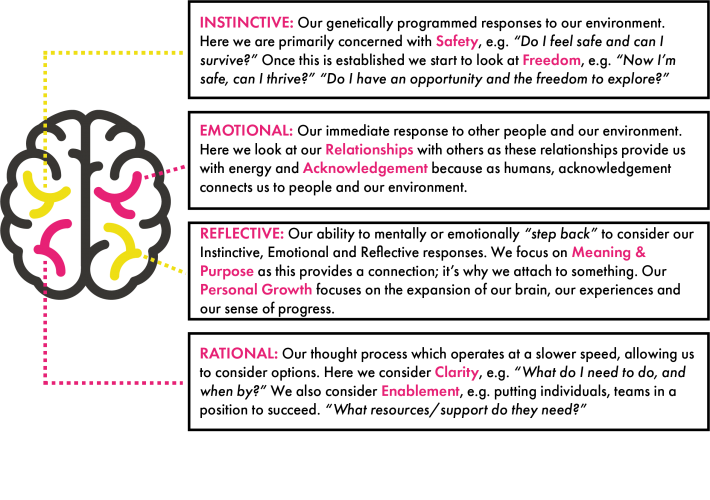
With the right balance of engagement and happiness, your organisation will achieve a thriving culture. In our Cultural Assessment model, we balance happiness and engagement, using neuroscience. Happiness relates to the Instinctive and Emotional parts of our brain. The Instinctive area of the brain deals with factors like Safety and Freedom. The Emotional area of the brain focuses on the factors of Relationships and Acknowledgment. On the other hand Engagement links to the Reflective and Rational parts of the brain. Our Reflective brain looks at factors such as Meaning and Purpose and Personal Growth. The Rational part of our brains deals with Clarity and Enablement.
When businesses understand how to measure the happiness and engagement of their people, and create action plans to improve both areas – they will reap the rewards of a happy, engaged and highly driven workforce. The healthy balance sheet will follow soon after!
LISTEN TO BILL KAHN
If you’d prefer to hear this from the man himself, then look no further! Click the button below and hear Bill’s thoughts on employee engagement as he chats with our Head of Global Happiness, Matt: