Categories
News

Future of Work Survey Results Revealed

Future of Work survey reveals key workforce challenges and skills

Harmonics, the Irish partner of OI Global Partners (one of the largest career consulting partnerships), has released the results of a proprietary survey of human resources professionals from North America, Europe and Australia. The goals of the survey were to identify the following:

  1. the skills employees must have to be competitive today;
  2. the most significant people challenges currently facing organizations;
  3. the roles most at risk; and
  4. the most effective ways to develop talent.

Clients of Harmonics and their counterparts with OI Global Partners across the globe shared their first-hand knowledge and insights in the Future of Work Survey.

John Fitzgerald, Managing Director of Harmonics, said, “The results are really insightful. Despite the differences in location and industry, there are common challenges and risks which our clients are facing and they are implementing solutions that are effective in managing an increasingly diverse workforce.”

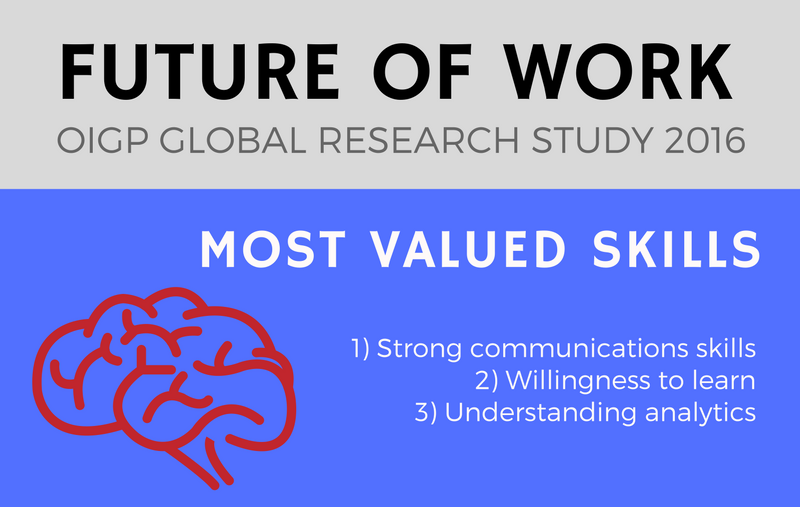
Among the key findings of the survey, respondents indicated that the skills employees must have to be competitive are strong communication ability (78%) and a willingness to learn (66%).  Understanding analytics came in third with 50% of the respondents citing this was a key skill.

John Fitzgerald noted, “Being open to learn, with solid reading, listening and thinking ability is seen as the second most valued skill. This can be seen as a reflection of how organisations are going through such rapid change and are looking for employees to adapt to change and take more ownership of their career development so they can bridge the growing skills gap.”

The most significant people challenges currently facing organizations are (1) attracting and hiring talent; (2) adapting to change; and (3) retaining talent.

The roles most at risk or in decline are:

  1. administrative roles;
  2. middle management;
  3. back office;
  4. support services; and
  5. technical roles.

“This is a reflection of the automation of roles – mobile internet, cloud technology, processing power, big data and the Internet of Things are all drivers of change,” commented John Fitzgerald.

Internal career development programmes were seen as the most effective way of developing talent according to 47% of the respondents, followed by career conversations (35%) and coach training.

Categories
Blog

4 Career Strategies for New World of Work

First Mover Advantage in the game of Career Chess

We regularly speak at ‘careers week’ events in corporate organisations to help offer fresh insights into career management in the changing world of work. As part of these events, there is often a company lifer rolled out to tell their career story about how they joined the organisation as a shy 22 year old, expected to stay for 5 years but they are still there 30 years later. The typical career story – a vertical career path from graduate to Manager to Director. This celebrates the message that a combination of lifetime loyalty and hard work pays off in the end.

Celebrate career agility, not lifetime loyalty

But how appropriate is it to showcase this message in today’s world of work? It is considered career suicide today to spend your life at one organisation and in one functional silo. Organisations are becoming flatter offering less promotion opportunities, so new routes to career success need to be urgently explored.

An interesting HBR study revealed 66% of employees don’t want to be managers.  The research continues to tell us that only 7% say they want to pursue C suite Executive Leadership level positions.  So when organisations are showcasing what career success looks like, they should not promote career progression as ‘up being the only way’.

Engaging the disengaged majority

The 66% of employees who don’t want to be managers are in the majority in every organisation.  And even though they form the backbone, there is often very little left in the budget for their career development.  If an organisation does not profile someone as a future leader, then potential career paths are rarely identified and career development is very much up to the individual.  Is it any wonder the Gallup survey on disengagement stands at 70%?

These two pieces of research tell us 66% don’t want to be Managers and 70% are disengaged. There must be some correlation. My view is that employees don’t believe their outstanding individual contributions are valued by the organisation. The only reward the organisation can offer is to promote them when someone leaves or retires. But is that what they really want? And is it the best match for their skills set.

Is it time to change the language of career success?

It is time for organisations to realise all successful career paths do not have to end on the senior leadership team.  The future of work is truly open, so organisations need to be open and honest with their people.  They need to help them to become realistic about their career futures rather than trying to tempt them into climbing the career ladder which might not be appropriate for their skill-set or sustainable for the organisation.

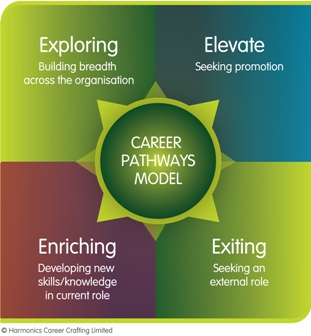
We have identified 4 clear career pathways that employees should consider:

Enrich – This is the most obvious but the least researched career path because it will show little movement on your CV. The enrichment strategy is really about seeking new ways to challenge yourself in your current role and develop new skills. The most practical way to enrich your current role is to become involved in a new project, this could be a cross functional project, or becoming skilled in a new technology that makes you more marketable. Your job title, grade level or status tells us nothing about your future ability to succeed and thrive in a changing world of work. It is your ability to be proactive, innovative and to collaborate that is considered currency for career success.

Explore – This pathway is about seeking opportunities in different divisions or departments across your organisation. It often involves taking a leap of faith into a new area that may make you feel vulnerable. Career growth only occurs when you step outside your comfort zone. It should never be about only wanting more financial reward but the longer term reward of becoming more employable. This strategy requires building relationships outside your own function that have the power to make things happen for you. The biggest barrier to exploration is personal self-confidence to begin self-marketing yourself for future internal opportunities.  If you don’t explore, someone less skilled may do and this increases frustration, so take action.

Elevate – This is the traditional route of upward career growth. One word of warning; make sure you complete a series of career assessments in advance of seeking a people management role. Secondly, invest in developing your people management skills as part of seeking any promotion. It’s tough managing people you once worked alongside in the trenches. Relationships change and you have to be ready for being unpopular and making hard calls. The road to promotion is littered with shattered egos and stressful sleepless nights. The glow of promotion soon wears off, so best be prepared as it’s not just about the increased monthly pay cheque. There is a reason you are paid more to climb a level!

Exit – I know many organisations are not promoting this as a career option. But it’s increasingly happening. There are more jobs offers externally. My advice here is not to be swooned by the recruiter promising the earth moon and stars in the new shiny company down the street. Like promotion decisions, think carefully about what enriches you personally and what you want. The lack of research people put into career moves is quite startling, they just accept information as gospel truth without doing their own digging. Always fully exhaust all internal conversations before this becomes the only option left. Lastly on this, organisations just have to become more resilient to accepting a certain level of churn at this time of increased opportunities.

First Mover Advantage

In truth, there will be different times throughout your career lifeline to employ each of the 4 career strategies above. In the world of work today, organisational change is inevitable and we all need to take personal ownership of our future careers. Proactivity is the key, waiting for the Organisation to make the first move means you offer up your first mover advantage!

Up is not the only way

Career Development needs to be for everyone. In the past, talent management was the preserve of the chosen high potentials prepared for the swift lift to the Top Floor. Career development helps employees become realistic about their career futures.

We have created a 24-7 anywhere, anytime access Gateway Career Portal which offers employees their bespoke Career Framework map plus thousands of Career Development resources at the type of cost that makes business sense to companies of any size.

Categories
Blog

Career Success Shouldn’t Be A Pyramid Scheme

I am always struck by how many people think that career success is all about promotion – getting to the next level and an increase in salary. The expectation is to follow the hero’s journey Hollywood style; by getting the next promotion all of our problems will be sorted and we will live happily ever after.

It may have worked in the traditional and hierarchical organisational structures of the past but times have moved on. In saying that, organisations continue to spend a lot of time and money profiling high potential talent and grooming them to be the leaders of the future. Succession planning appears to be focused on the talented favourites. They are promoted or sent on management development programmes as a reward for high performance in their current role despite the fact that performance in a current role is no indicator of success in a management position.

Great succession planning, in an ideal world, would have a subs bench-primed with ready now and ready soon leaders to fill any gaps that may appear if someone moved or left at short notice. Reality, as we know, is often very different.

So is this talent development approach for upward only moves setting employees up for an extended period on the subs bench without experiencing the real thing? Is it created a frustrated level of hi potential talent ready to be poached by a recruiter? Has the organisation thought about what these people actually want? Do they as individuals know what they want?

The first question to be addressed is: What do people really want? HBR Research shows us that most people don’t want to be managers and only one third of employees aspire to management positions at any level. That’s right only 34% really want to manage people and only 7% want to work at Executive level.

Up is not the only way

Career progression should not equal promotion. If it’s not what everyone wants, then why do so many see the next level as the Holy Grail. The challenge, we see in our coaching practice, is that there are just not enough promotion opportunities in flatter organisation structures today. There are fewer levels to climb thus creating this ‘mud layer’ of people stuck at a mid-management level and even greater numbers below having no realistic opportunity of gaining promotion.

It is time to change the language of career success away from the traditional and hierarchical industrialised pyramid structure of “up being the only way” because the pyramid is filled with unintended and unsustainable consequences.

Start with the end in Mind

Before selecting a candidate for a management or leadership position or indeed a management development programme, we advise organisations to put their talented individual contributors through a 1-1 Career Stocktake programme to help them identify their personal career strengths and make a fully informed decision on what they want for their future career rather than accepting what someone else says would be good for them. We know from research that 70% of interviewees reported chance events had significantly impacted their career choices. Individuals simply do not put enough research our self-assessment time into plotting future career moves. Too many simply respond to a ‘tap on the shoulder’ suggesting a great move for you would be…… In this future world of work we all need to create our future career direction.

Right person for the right career move

Individuals need help to do this and our Career Stocktake career coaching programme helps them bridge the gap from where they are now to their best future career move. Typically delivered over three intensive career coaching sessions with access to our suite of career assessments, the programme helps individuals realise what they want and for the organisation to know they have the right person as a candidate for a management role.

It’s also time for organisations to communicate more that all successful career paths do not have to end at the top of the pyramid scheme on the senior leadership team. In our next blog we will look at our Career Pathways Model – where organisations and managers can help staff to follow realistic career paths.

It is wise for individuals to follow their intrinsic motivational drivers in selecting future career moves and not be swayed by extrinsic career offers that may be someone else’s view of career success. Create, and continue to refine, your career path in alignment with market demand. Real life is not like the movies and up is not the only way!