
Categories
Blog

Career Framework Mapping – the Do’s & Don’ts

Managing the growing career aspirations of a diverse workforce is proving to be a big challenge for HR Departments. In response, many organisations are introducing new career frameworks. The purpose of a career framework is to show employees where they sit in the overall organisation, what job family they belong to and what competencies are required to succeed in their current role or other roles.

But the career framework is only a visual representation of all of the roles, job families and levels in the organisation. It’s a lot like getting a map of a six storey hotel complex which shows you that it has so many rooms on each floor. The rooms on the bottom floor room cost less and the room rate increases as you move up the floors until you reach the suite on the top floor. This top floor, where the CEO resides, should give them a panoramic view of everything going on in the Organisation.

The map is not the territory

However, the map is not the territory; it is purely a visual representation of the Organisation. What many forget when introducing career frameworks is that the map does not show the reality of what is really going on. It fails to show the many broken lifts in the hotel stopping great people from moving up, the rooms that are locked by managers trying to hide their talent, those who have reached the fifth floor through having a corporate sponsor, the rooms that were acquired as a favour as part of a special thank you, the rooms where poor performers lie, where the lifers reside and rarely ever check out and the mission critical rooms – where the most talented inhabit. And if they were to leave it would automatically raise the alarm on all floors; it may even lead to an evacuation of more talented people in time.

Top 7 Challenges with Implementing a Career Framework

Before an organisation considers building a career framework it needs to get the foundations right. From our experience, here are the top seven challenges that need to be addressed in launching and implementing a new career framework:

  1. A career framework needs to be an organisation wide initiative and not just something that HR imposes on the business. It’s important to set up a cross functional working group who are representative of the diverse departments and workforce in the organisation.
  2. Career progression is mostly seen by employees as promotion, a pay increase and a new job title. There needs to be a shift in mindset that career progression is about building new skills and breadth in your career and not just promotion.
  3. In a new career framework, employees will see where they sit as part of the whole organisation. It is imperative that realistic career journeys are included on the framework to spotlight potential career building moves through both lateral and vertical moves across functional silos. These potential career journeys then spark career conversations for employees to have outside of their own function. This broadens their mindset about the career options available to them internally rather than jumping ship and can prove an excellent retention strategy.
  4. Managers need to understand the benefit of having career conversations with not only their own reports but also with those across the business. This is a major stumbling block as often managers are purely focused on hitting the business numbers and ‘fear the soft and fluffy career development discussions’. The reality is that recruiters are calling these same employees on office time with new job offers. They are offering employees more career development time than their managers which is a huge missed opportunity. Managers need to enable their people create new career growth opportunities. See our recent blog on a new model for talent retention here
  5. Talented Millennials are seeking rapid promotion and are often disappointed that it’s not possible to get promoted every second year. The reality is that organisations are flatter today so lateral career building moves are the only realistic way to grow a career and this needs to be communicated.
  6. There needs to be a greater acceptance that talent will leave whatever you do. Holding back employees is not good for business or their career growth. If an organisation doesn’t have a role that can offer them career growth, then an adult to adult career conversation must take place. They will appreciate it and may come back again with newer skills in a few years or even recommend a colleague to come work for the firm now.

Career Development Principles workshop

We have created a Career Development Principles workshop for OD, L&D and HR specialists within organisations tasked with introducing Career Frameworks. The workshop provides a structured template to guide and challenge participants thinking on the ‘what’, ‘how’ and ‘why’ involved in introducing career frameworks into a unique culture.

Career Development needs to be for everyone. In the past, Talent Management was the preserve of the chosen high potentials selected for the swift lift to the next floor. We have created a 24-7 anywhere, anytime access Gateway Career Portal which offers employees their own bespoke Career Framework map plus thousands of Career Development resources at the type of cost that makes business sense for companies of any size. Check out this two minute video tutorial of our career management portal.


Categories
Blog

Talent Management in Financial Services

Contribute to a Global Report on Talent Management in Financial Services

We are seeking your assistance in uncovering global insights that will prove helpful in benchmarking career development in the financial services industry.

This quick survey take less than 5 minutes to complete.  Your answers will remain anonymous and will be combined with the responses of other organisations globally in a white paper by OI Global Partners.

Thank you so much for sharing your knowledge about career management in the Financial Services Industry.  If you would like to receive a copy of the report, please contact us directly.

Categories
Blog

Is it time to reassess your career game?

Rethinking the Second Half of Your Career

The second half of your career is longer than you think

I met James last week. Twelve months ago he made a really big decision. At 48 he returned to college full time to complete a one year MBA.

The journey back to full time education started for James after I worked with him on his Executive Outplacement Programme. His senior global role was made redundant, but he had already become jaded by weekly air travel (he has amassed free air miles for the rest of his life!)

During our one-to-one sessions, he discovered he didn’t want to continue on this corporate global journey nor at the same pace. He budgeted what he needed to put aside and, with his redundancy package as a buffer, he made the decision to go back to full time study – it was his missing link. The light bulb moment happened when I drew his career lifeline on a flipchart. It had three ages on it 18, 48 and 78.

18________________________48________________________78

He was only half way there.

I am turning 50 this month and I know that by the time I reach 78, this will be closer to the official retirement age, not 68. This is the reality of an aging global population, our current lifestyles and insufficient pension funds for the future.

But if we reassess our career game plan, we can look forward to the next 30 year stretch as an opportunity for rebirth and personal growth, rather than something that we have to get through.

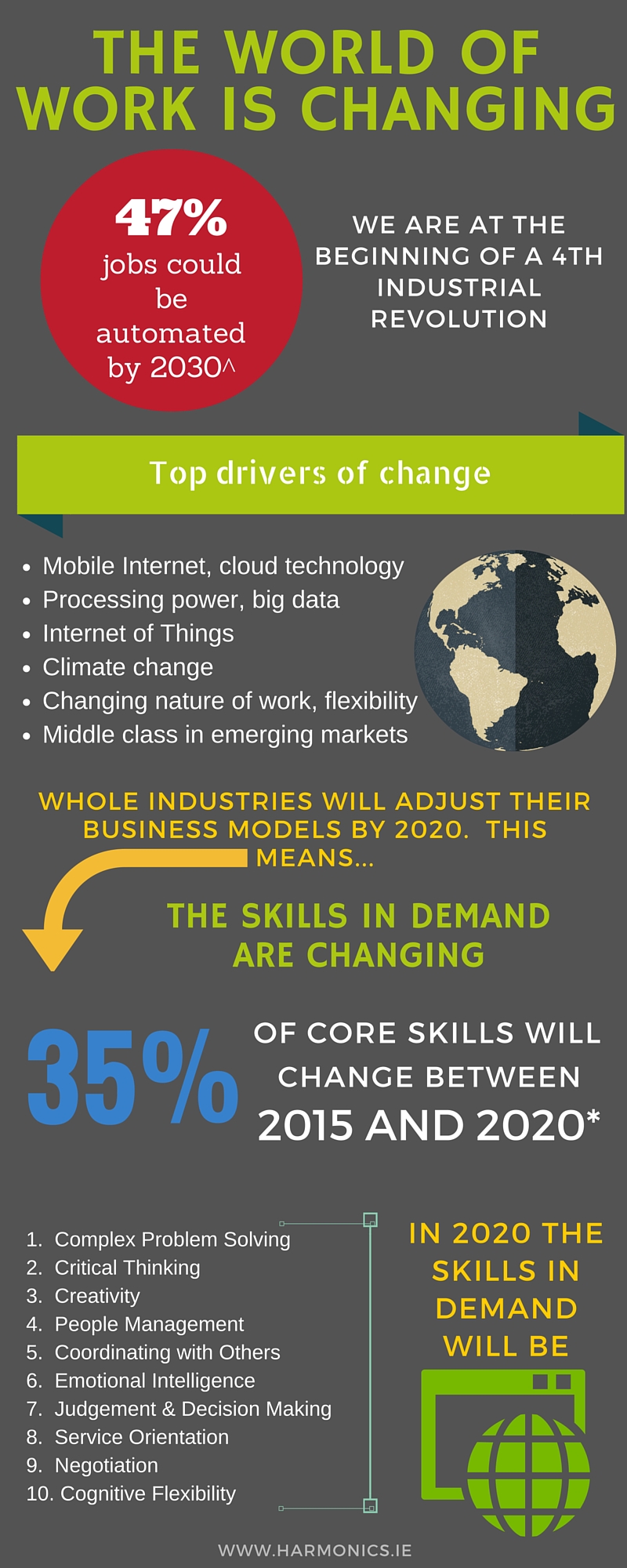
At 18 we look forward to the next few years of college life as a time to combine study, carefree fun and independence for the first time; somewhat naive, wide-eyed and hopeful for the future. However, the World of Work is Changingrapidly and one intensive three or four year block of study is no longer adequate. Long-term employability means having diverse and up-to-date knowledge and skills.

The impact of seeing this lifeline prompted James to see the next 30 years as an opportunity rather than a problem. It’s a brave call but he has created a new platform to pivot in a new career direction.  He is now as enthusiastic as a fresh faced college grad of 22.

He sees the future world of work with new eyes and has already built a totally new network. He has been able to bring years of international business experience and marry it to the latest business thinking and models. This fusion of valuable work experience and learning has made his MBA much more relevant and rewarding.

The qualification was something he personally felt was missing but not just on his CV; James also wanted to test himself academically. He is now in the top quartile of the class which has greatly increased his self-confidence. It has given him a second wind for the second half.

There are many people like James who, for whatever reason, are offered a redundancy package to leave in their 40’s or 50’s. But instead of taking the time to reassess and reinvest in themselves, they think about the next 30 days, the quick fix and rush into job seeking mode rather than setting themselves up for the next 30 years.

They find a new job and continue to work hard but it is never as good as where they were. They keep scanning the job sites for the role they hope will take them back to the good old days.  The next 30 years for them will be a continual decline, spiritually, emotionally, financially and physiologically.

Going back full time to college may not be possible for everyone, but learning and upskilling is becoming essential as identified in recent McKinsey research. The opportunity to reassess and recalibrate is always an option. The latter half of your career does not need to be like the first half. In the European championships this month, we will see teams adapt and change their game plan for the second half to get the result they want. The successful teams will use half time to reassess, re-energise and refocus their priorities. They will also have coaches who continually challenge them to be at their best.

The reality is we will all be living and working longer. The second half can be the most rewarding time in our lives but only if we are brave enough to re-evaluate what we have to offer, what will be in demand in the future and what we need to learn and do to bridge that gap.