
Categories
Blog

Wright Brothers

The power of a beginner’s mindset in times of change

“It’s hard to reach a certain stage and have to start learning again”

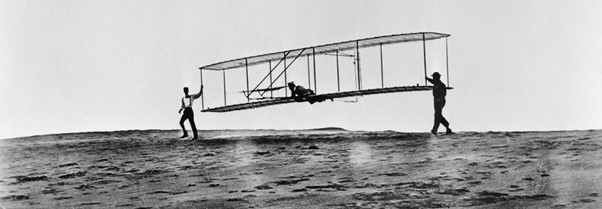
At the turn of the last century, two bicycle builders became the first in the world to fly a plane. They won the race against the expert astronomer, physicist and inventor, Samuel Langley who was backed by €2 million in grants (in todays money) to complete the project

So what was their secret formula?

The Wright Brothers had a Beginners Mindset and began exploring with curiosity. They took a design thinking approach, they knew they would fail many times, but every experiment was an opportunity to learn.

Langley, however was weighed down by rules and theory and years of expertise in his field. He had an Expert Mindset, he discounted many possibilities and narrowed his options too fast.

In a recent coaching session, a Senior Leader said to me “It’s hard when you reach a certain stage in your career and have to start again”. He fears making a mistake, fears asking for help. His ego is getting in his way.

I would encourage anyone fearing change to combine your current knowledge and expertise with the curiosity of the beginners mindset.

In todays world, we are all beginners, we have never experienced a time like this. We need to let go much of what we know to be true

The Wright’s were right:) #curiousity

Categories
Blog

Lockdown Window

Turning Well Meaning Into Real Well Being During Lockdown

Every call I have had this week, the topic of well being has been mentioned.

One client is doing a Well Being fortnight, another has Wellness Wednesdays where no online meetings are supposed to happen…but they still do!

These HR led initiatives highlight a focus on taking care of ourselves.

The real question is how do we turn well meaning for well being into feeling well and confident to face the future through lockdown?

Our work and life environments have changed and are likely to never go back to where they were pre-covid.

Many of us are on Zoom or Teams calls all day with one glimpse of the outside world through our #LockdownWindow in my case my skylight window.

This isolation is having a huge impact on people. At Harmonics, we are on a mission to help Organisation Leaders truly listen and care for their people.

Leaders and Managers need to purposely build even greater emotional connections with their people by creating the time for quality conversations.

We have used the Lockdown to create new technologies like Employee Voice 24/7 to work as an internal communications coach and our Future Readiness Index to enhance our 5 Step Career Conversations Masterclass series

Take a look and give us a call on the link here. https://lnkd.in/ecmBiT4

Categories
Blog News

Future of Work 2020 Research Study Launched

IMPACT OF COVID-19 & DIGITAL TRANSFORMATION ON WORLD OF WORK REVEALED

Future of Work Research Study Examined Changing Landscape of Skills in Demand, Work Environments and Technology

23 November 2020: A global survey of Business and HR Leaders conducted by Irish firm Harmonics and OI Global Partners (one of the world’s largest career consulting partnerships) has captured some of the positives, negatives and challenges that the pandemic and digital transformation are bringing to the world of work.

This is the fifth annual survey that Harmonics has conducted in association with OI Global Partners on the Future of Work and the implications from the pandemic were felt right across organisations.

Some of the key take-aways include:

  • 43% of global respondents believe Covid-19 had a positive impact on productivity. When looking at Irish respondents this rose to 69%.
  • By comparison, 46% of respondents in Ireland (and globally) perceive a negative impact on collaboration because of fewer informal interactions.
  • The impact of remote working has led 71% to anticipate a hybrid form of work in the future with some division to time spent between home and the workplace.

Commenting on these findings, John Fitzgerald, managing director, Harmonics, said, “Hybrid working is here to stay so we need to continue to find ways to stay connected and to collaborate effectively in virtual environments. The big question for employers now is how do we create greater teamwork, better conversations and well-being in a very scheduled online meeting led world of work?”

Virtual workforce mobility is another trend emerging in a tight global labour market for specific skills. Organisations can now hire someone from anywhere in the virtual world. We will start to see more examples of a person living in Japan working for a company in Dublin for instance or someone living in Kerry working for a company headquartered in Berlin,” he continued.

The top 5 skills most valued by organisations are:

  • Leadership agility
  • Embracing Change
  • Collaboration
  • Communicating Clearly
  • Critical Thinking

“We saw the same top 5 in 2019, although leadership agility has jumped three places to the top.  Digital transformation has accelerated apace because of Covid-19 and this has increased the need for an agile mindset to embrace change and learn new ways of work. Career success is very much mindset led and skillset enabled,” Mr Fitzgerald noted.

Other key findings include:

  • 46% say that ‘adapting to change’ is the biggest people challenge facing their organisation, followed by ‘managing remote workers’ (43%) and keeping employees engaged (42%).
  • By contrast, in Ireland, the biggest people challenge is ‘preparing for the unknown’
  • The transition to a remote working environment has increased responsibility for each employee to self-direct their own career development. Self-directed learning portals garner support from 45% of survey participants this year, the highest rated development activity and one that has not made the top list in previous years.
  • Just over half of survey participants predict that new technology (e.g., artificial intelligence, big data, machine learning) will have no impact on jobs (56%). This is an increase from 2019, when 38% of responses fell into the “no impact on jobs” bucket.
  • Turning to the impact of new technology on social skills, more than 3 out of 4 of overall survey participants (77%) believe that new technology will require more social skills.

Mr. Fitzgerald said, “The impact of digital transformation and ongoing technology advancements are increasing the need to reskill to meet changing work demands. However, in Ireland there appears to be a significant gap in businesses committing to investing in upskilling their people. Only 16% Irish employers stated they are currently investing in reskilling, while 66% said they would do so in the future. This may impact the ability of people to quickly transition to new jobs that require an increasing hybrid of digital and social skills.”

The Global Future of Work survey results can be downloaded here OIGP-FOW-2020-IRL

ENDS

About the survey:

The survey was conducted in September and October 2020. There were almost 600 respondents from 16 countries.  Organisations of all sizes weighed in, with half reporting more than 500 employees. Respondents represented every one of 16 major industry groups, with heaviest response from Financial Services, Business Support & Logistics, Technology, Telecom, Internet & Electronics and Manufacturing.

About 50% of the respondents are from the UK and Europe, with the largest representation from Ireland, Netherlands and Nordic countries. Slightly fewer respondents (48%) come from Canada and the US and 3% represent Australia.